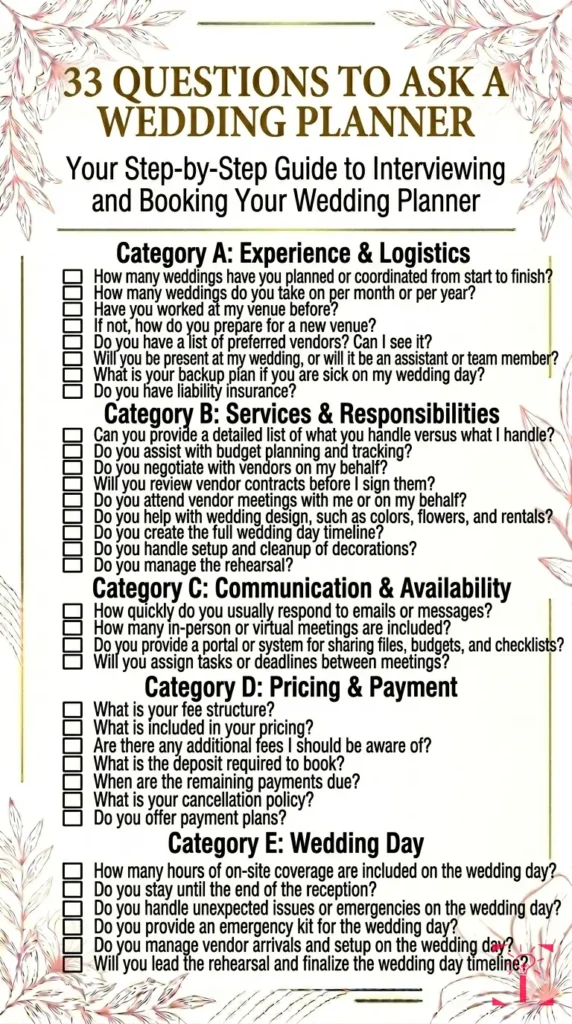
33 Questions to Ask Wedding Planner
Category A: Experience & Logistics (The Basics)
- How many weddings have you planned (or coordinated) from start to finish?
(Look for at least 20–30 if they are full‑service. For the month-of, 10+ is fine.) - How many weddings do you take on per month or per year?
If they do 10 weddings in one month, you will not get much attention. 2–4 per month is typical for a solo planner. - Have you worked at my venue before?
If no, “How do you learn a new venue?” (A good answer would be “I visit ahead of time or call the venue manager.”) - Do you have a list of preferred vendors (photographers, caterers, DJs)? Can I see it?
A good planner has trusted vendors. But be careful because some get kickbacks. Ask about that (see secret questions later). - Will YOU be the one at my wedding, or will you send an assistant or team member?
Make sure you know who is actually showing up. If they send an assistant you have never met, that’s a problem. - What is your backup plan if you are sick on my wedding day?
They should have another professional planner on call. “I would never be sick” is not a real answer. - Do you have liability insurance? (Many venues require it. Ask to see a certificate.)
💍 As you explore these ideas, our step-by-step
How to Plan your Wedding guide can help you build your actual plan along the way.
Category B: Services & Responsibilities (What Exactly Do You Do?)
- Can you send me a detailed list of everything you handle vs. what I handle?
This is very important. Some planners do not set up decorations. Some do not handle cleanup. Get it in writing. - Do you help with budget planning and tracking?
(Yes for full‑service. Sometimes no for month‑of.) - Do you negotiate with vendors on my behalf?
A good planner will save you money by negotiating. Ask for examples. - Will you review vendor contracts before I sign them?
(Yes, this alone can save you from bad deals.) - Do you attend vendor meetings with me (or on my behalf)?
(Full‑service planners often attend or even go alone.) - Do you help with wedding design (colors, flowers, rentals) or just logistics?
(Know what you are paying for.) - Do you create the full wedding day timeline? How far in advance?
(Usually 4–6 weeks before the wedding.) - Do you handle setup and cleanup of decorations?
(Some planners do not touch decorations. If that matters to you, ask.) - Do you manage the rehearsal? How long?
(Usually 1 hour, including a walk‑through.)
Category C: Communication & Availability
- How quickly do you usually reply to emails or texts?
(Same day or within 24 hours is good. “Within a week” is too slow.) - How many in‑person or video meetings are included?
(Unlimited is nice, but 1–2 per month is typical.) - Do you have a portal or app where we can share files, budgets, and checklists?
(Many planners use tools like Aisle Planner, HoneyBook, or Google Drive.) - Will you give us homework or deadlines between meetings?
(Yes & this keeps you on track.)
Category D: Pricing & Payment
- What is your fee structure? (Flat fee? Percentage of wedding budget? Hourly?)
- Flat fee is easiest to understand.
- A percentage can be risky if your budget grows.
- Hourly is rare for full planning.
- What exactly is included in that price? (Ask for a written list.)
- Are there any extra fees I should know about? (Travel, parking, overtime, assistant fees, phone calls after hours.)
- How much is the deposit to book? (Typically 25–50%.)
- When are the remaining payments due? (Monthly? One lump sum before the wedding?)
- What is your cancellation policy? (If you cancel, do you get any money back? If they cancel, do you get a full refund?)
- Do you offer payment plans? (Many do.)
Category E: The Wedding Day Itself
- How many hours of on‑site coverage are included on the wedding day?
(Month‑of coordinators often work 8–10 hours. Full‑service may be from setup to cleanup.) - Do you stay until the end of the reception?
(Some leave after cake cutting. Ask.) - Do you handle emergencies (e.g., a vendor doesn’t show up, a guest gets sick)?
(Yes, a good planner is a problem‑solver.) - Do you have an emergency kit (safety pins, stain remover, Band-Aids)?
(Small thing, but very helpful.) - Do you manage the vendor arrival and setup schedule?
(Yes, they should be the point of contact for all vendors on the day.) - Will you hold the rehearsal and the wedding day timeline meetings?
(Yes, these are standard.)
Question 1: “Can I talk to two or three couples you worked with in the last year?”
- Good answer: “Absolutely, here are their emails and phone numbers.”
- Red flag: “I don’t give out client info” or “Let me check if they are okay with that.” (They should have already asked past clients for permission.)
Question 2: “Tell me about a wedding that went wrong. What happened and how did you fix it?”
- Good answer: Honest story with a solution (e.g., “The florist was two hours late, so I ran to a grocery store and bought backup flowers while the bride got ready.”)
- Red flag: “Nothing ever goes wrong at my weddings.” (That’s a lie.)
Question 3: “What is something couples often forget to ask you about?”
- Good answer: “Parking fees for vendors,” or “That I don’t do setup of personal decorations.”
- Red flag: “I can’t think of anything.” (Then they surprise you later with extra costs.)
Question 4: “Do you receive any commissions or kickbacks from vendors you recommend?”
- Good answer: “Yes, sometimes, but I always tell you, and I only recommend vendors I truly trust. You can use anyone you want.”
- Acceptable: “No, I never accept kickbacks.”
- Red flag: “That’s none of your business” or “Why would you ask that?” (Walk away.)
Question 5: “Have you ever fired a client? Why?”
- This reveals their boundaries. A good answer might be: “Once, because the client lied about their budget and expected me to work for free.” That’s fair. A bad answer is ranting about a past client.
Save it on Pinterest or Print this!