
How to Choose Your Wedding Caterer
Food feels like just one line item on your wedding checklist. Sorry to break it to you, it isn’t.
It’s the thing people quietly judge the entire day by. No one goes home talking about your table linens in detail, but they will remember if the food was incredible, or if it showed up cold, ran out halfway through cocktail hour, or came with service that felt… off. Those are the stories that stick.
And then there’s the pricing.
You’ll see a per-person cost that looks perfectly reasonable. Manageable, even. And then the rest appears. Service charges. Staffing. Rentals. Gratuity. Suddenly, that “simple” number isn’t so simple anymore, and the total climbs faster than you expected.
This is where most people get overwhelmed, not because catering is complicated, but because no one explains how it actually works.
So that’s what this guide does.
I’ll walk through everything, step by step. What kind of caterer you actually need? How to find one that’s worth it? What to ask before you sign anything? How do tastings really work? What do those contract terms mean when you read the fine print? And how to make decisions without second-guessing every line item.
And the food? It stays something people rave about, for all the right reasons.
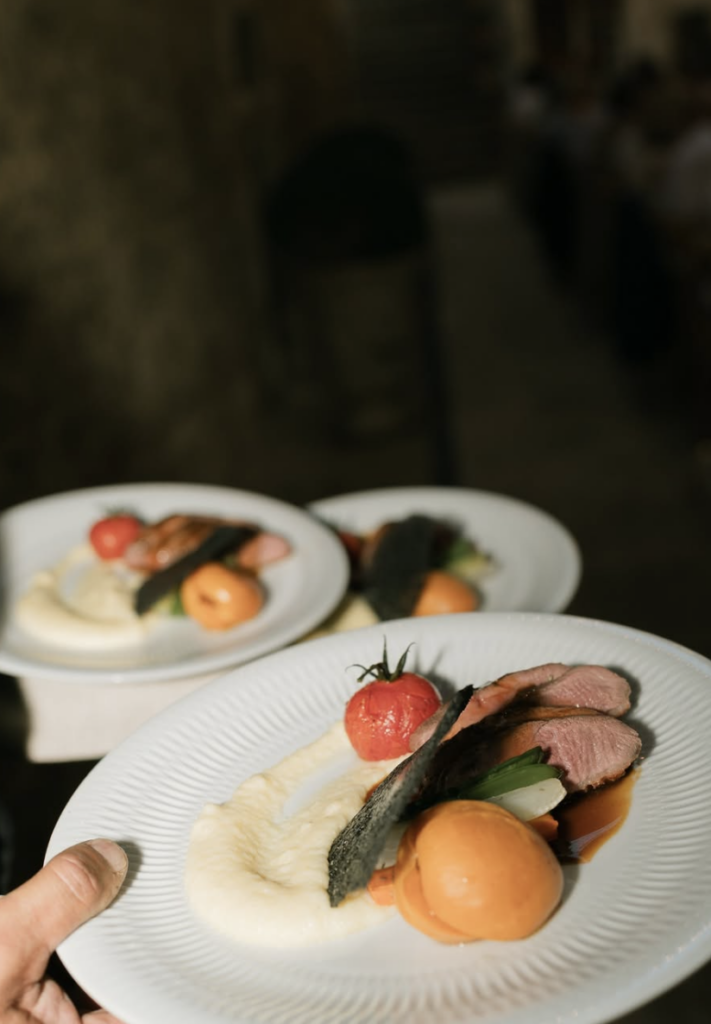
Part 1: First, Understand What a Caterer Does (And Doesn’t Do)

What a Caterer Does
- Provides all the food (appetizers, dinner, late‑night snacks, etc.).
- Provides beverages (water, soda, juice, coffee, tea, and alcohol, which is often separate).
- Provides serving staff (servers, bartenders, chefs, and event managers).
- Sets up the dining area (tables, chairs, linens, china, glassware, flatware, sometimes these are rentals).
- Serves the food (buffet, plated, family style, or food truck).
- Cleans up after the meal (clears tables, packs up leftovers, removes trash).
What a Caterer Usually Doesn’t Do
- Provide alcohol (some do, some don’t. Ask).
- Provide the wedding cake (that’s your baker).
- Provide flowers, centerpieces, or decor (that’s your florist or DIY).
- Provide a dance floor, stage, or AV equipment (that’s your venue or rental company).
- Stay for the whole reception (they clean up after dinner and may leave before dancing ends. Confirm beforehand).
Types of Caterers (So You Know What You’re Paying For)
| Type | What They Do | Best For | Typical Price Per Person |
|---|---|---|---|
| Full‑service caterer | $15 – $30 (per truck, minimums apply) | Couples who want zero stress | $40 – $100+ |
| Drop‑off caterer | Delivers food in chafing dishes. No staff. You need to hire servers or have family help. | Tight budgets, casual weddings | $15 – $30 |
| Food truck / casual caterer | One or two food trucks. Fun, casual, often cheaper. Limited menu. | Laid‑back weddings, smaller guest counts | $15 – $30 (per truck minimums apply) |
| Venue‑in‑house caterer | The venue provides the food. Very convenient, but you can’t shop around. | All‑in‑one venues | Varies widely |
Most couples choose a full‑service caterer. That’s what this guide focuses on, but the questions work for any type, if you ask me.

Part 2: Know Your Catering Budget Before You Call Anyone
A good rule of thumb: 30–40% of your total wedding budget goes to food and drink (catering + alcohol).
For a $20,000 wedding, that’s $6,000–$8,000 for catering and bar combined.
What Affects the Cost
- Number of guests: This is the biggest factor. More people = more food, more staff, more rentals.
- Style of service: Plated dinners need more servers than buffets. Food trucks can be cheaper per person but have minimums.
- Menu complexity: Steak and lobster cost more than chicken and pasta. Seafood costs more than vegetarian.
- Staffing: More servers, bartenders, and chefs = higher cost.
- Rentals: Tables, chairs, linens, china, glassware. Some caterers include them, some don’t.
Average Per‑Person Costs (Estimate – Varies by Region)
| Service Style | Low End | Mid Range | High End |
|---|---|---|---|
| Drop‑off / casual | $15 | $20 | $30 |
| Buffet | $25 | $35 | $50 |
| Plated dinner | $40 | $60 | $100+ |
| Food truck | $15 | $25 | $35 |
These are just for food. Add 18–22% for service charge, plus tax, plus travel fees, plus alcohol if you’re serving it.
Part 3: Where to Find Wedding Caterers (And How to Spot Bad Ones)
Good Places to Look
- Your venue’s preferred vendor list – Some venues require you to use their caterers. Even if not, these caterers already know the space.
- Wedding Wire and The Knot – Filter by price, read reviews, see real wedding photos.
- Instagram – Search “[your city] wedding caterer” or “[your city] event catering.”
- Local Facebook wedding groups – Ask for real couple experiences.
- Your wedding planner’s recommendations – Planners know who is reliable.
Red Flags to Watch For
- No tasting offered (or charges a very high non‑refundable fee with no option to apply to your booking).
- Won’t give you a written proposal or per‑person breakdown (only verbal quotes).
- Bad reviews about food quality – “Cold,” “bland,” “ran out of food,” “guests got sick.”
- Bad reviews about staff – “Rude,” “late,” “didn’t clean up.”
- Unclear about fees – They say “service charge” but won’t tell you if it goes to staff or the company.
- Requires full payment upfront with no contract.
Part 4: Before You Reach Out – Get Your Own Answers Ready
Having these things written down will save you time and help caterers give you accurate quotes.

Know Your Guest Count
Even an estimate is fine. “Around 120 guests” is better than “I don’t know.”
Know Your Service Style Preference
- Plated dinner: Guests stay seated, servers bring each course. Most formal.
- Buffet: Guests walk through a line. Less formal, often cheaper.
- Family style: Large platters on each table, guests pass them around. Interactive and warm.
- Food truck: Fun and casual. Best for outdoor or barn weddings.
Check out our article on How to Choose Your Wedding Food & Drink Menu
Know Dietary Restrictions
Ask your guests roughly: “About 10 vegetarians, 2 gluten‑free, 1 vegan.” Caterers need to know.
Know Your Budget Per Person
Example: “We want to spend around $45 per person for food, plus drinks.”
Know Your Venue’s Kitchen Situation
Does your venue have a full kitchen? A prep kitchen? No kitchen at all? This affects what caterers can do.
Message Template to Send Caterers
“Hi [caterer name], We are getting married on [date] at [venue] with about [120] guests. We’re interested in a [buffet / plated dinner] with a budget around [$45] per person for food. Do you serve our area? Do you offer tastings? Could we get a sample menu and price sheet?”
Send this to 3–5 caterers. See who replies with clear info and a friendly tone.
Part 5: The Tasting & Consultation – What to Expect
The tasting is one of the best parts of wedding planning. Here’s how it usually goes around.
Scheduling
- Many caterers offer free tastings for couples seriously considering them.
- Others charge a small fee ($50–$100 for two people). This fee is often refundable if you book.
- Tastings are usually in person at the caterer’s kitchen or a partner restaurant.
What You’ll Do
- Taste 3–5 menu options (appetizer, salad, entree, dessert, not wedding cake, that’s separate).
- Meet the chef or event manager.
- Discuss your vision, guest count, and budget.
- Ask all your questions (see the list below).
What to Bring to the Tasting
- Your guest count and budget.
- Any dietary restrictions you know about?
- Your questions (print them out if helpful).
- A notepad or phone to take notes.
Pro Tip: Don’t Go Starving
Tasting multiple rich dishes on an empty stomach can be overwhelming. Eat a light snack beforehand. Bring water.
After the tasting, the caterer should send you a written proposal with per‑person pricing and a full breakdown of fees.
Part 6: The Big List of Questions to Ask (Organized by Category)
You can use these questions during the tasting or on a pre‑tasting call. They will help you narrow your options & pick the best fit for you.

Category A: Experience & Logistics
- How many weddings have you catered?
(At least 50+ is good for a professional. 100+ is even better.) - Have you worked at my venue before?
If no: “Will you do a site visit beforehand?” (They should.) - How many weddings do you take on per day?
(If they do 5 weddings on the same Saturday, your event might get stretched, staff.) - Do you have a commercial kitchen, or do you cook on site?
(Cooking on site is often fresher, but requires venue kitchen access.) - What is your backup plan if a staff member doesn’t show up or food is delayed?
(Good answer: “We have on‑call staff and extra ingredients.”) - Do you have liability insurance?
(Most venues require it. Ask for a certificate of insurance.)
Category B: Menu & Food Quality
- Can you customize the menu?
(Some caterers have fixed menus. Others will work with you to create something unique.) - Do you accommodate dietary restrictions (vegetarian, vegan, gluten‑free, allergies)? Is there an extra charge?
(Most caterers do this for free, but some charge $5–$10 per special meal.) - Do you use fresh or frozen ingredients?
(Fresh is almost always better. If they say frozen, ask why, because sometimes it’s necessary for certain dishes.) - Can you provide a children’s meal at a lower price?
(Often half price for kids under 12. e.g., chicken fingers and fries.) - Do you offer a late‑night snack (e.g., sliders, fries, pizza, cookies)? Extra cost?
(Many couples add this for $5–$15 per person. Ask if it’s worth it because some guests are too full.) - What happens if food runs out?
(Good caterers prepare 5–10% extra. Ask: “Do you have backup portions?”)
Category C: Service Style & Staffing
- What service styles do you offer? (Plated, buffet, family style, food truck.)
- How many servers do you provide per guest?
- Plated dinner: 1 server per 20–30 guests.
- Buffet: 1 server per 30–50 guests.
(Ask: “Is that enough for our timeline?”)
- Is there a head chef or event manager on site during the wedding?
(Yes, there should be a point person.) - Do you provide bartenders? (If you’re serving alcohol, it’s an essential.)
- Do you handle setup, serving, and cleanup of the dining area?
(Yes, that’s standard for full‑service caterers.) - Do you clear plates and reset tables? (For plated dinners, yes. For buffets, sometimes less clearing.)
Category D: Rentals & Equipment
- Do you provide tables, chairs, linens, china, glassware, and flatware? Is there an extra fee?
(Some caterers include basic rentals. Others charge extra. Get a line item.) - If not, do you have a list of rental companies you recommend?
(Good caterers will have trusted partners.) - Do you provide chafing dishes, serving utensils, and heating equipment?
(For buffets, yes. Confirm.) - Who is responsible for the cleanup of rental items?
(The caterer should pack them up. You shouldn’t have to wash dishes.)
Category E: Pricing & Fees (The Most Important Part)
- What is your price per person? Get a line‑item breakdown:
- Food cost
- Staffing cost
- Rentals (if any)
- Delivery/travel fee
- Is there a service charge? (Often 18–22%. Ask if it goes to the staff or to the company. If it goes to the company, you still need to tip staff separately.)
- Is gratuity included or separate?
- If included: You’re done.
- If not: Plan to tip 15–20% of the food bill (not including service charge or tax).
- What is the minimum guest count? (Some caterers have a minimum of 50 or 100 guests. If you have fewer, you might pay a flat fee.)
- How much is the deposit to book? (Usually 25–50% of the estimated total.)
- When is the final payment due? (Often 1–2 weeks before the wedding.)
- What is your cancellation policy?
- If you cancel: Is the deposit refundable? (Usually not.)
- If they cancel: Do you get a full refund? (Yes, plus help finding a replacement.)
- What is your policy on final guest count changes?
(Most caterers require the final number 7–14 days before the wedding. You can usually lower the count up to that deadline.)
Category F: Alcohol & Bar Service (If Applicable)
- Do you provide alcohol, or do we need a separate bar service?
(Some caterers have a liquor license and full bar service. Others only do food.) - Do you have a liquor license? (Required if you’re selling alcohol. For a hosted bar where you buy the bottles, you may not need one. Ask your venue.)
- What are your bar package options?
- Open bar: Guests drink free. Most expensive.
- Consumption bar: You pay for what guests actually drink. Risky if guests drink a lot.
- Limited bar: Beer, wine, and one signature cocktail. No full liquor.
- Cash bar: Guests pay for their own drinks. Many couples avoid this, but fair warning tho guests don’t like it.
- Do you charge a corkage fee if we provide our own alcohol?
(Often $5–$15 per bottle of wine, $2–$5 per beer. Ask if it’s worth it because sometimes buying from the caterer is cheaper after fees.) - Who checks IDs and monitors guest intoxication?
(The caterer’s bartenders should. If they don’t, you could be liable.) - Do you provide non‑alcoholic beverages (water, soda, juice, coffee, tea)? Included or extra?
(Usually included in the per‑person price for non‑alcoholic. Confirm beforehand.)
Part 7: The “Secret” Questions That Reveal Problems
These questions show you if the caterer is honest and experienced.
Question 1: “Can I speak to two recent couples you catered to?”
- Good answer: “Absolutely, here are their emails and phone numbers.”
- Red flag: “I don’t give out client info” or “Let me check.” (They should have permission already.)
Question 2: “Tell me about a wedding where something went wrong (food cold, ran out, staff late). What did you do?”
- Good answer: An honest story with a solution (e.g., “The oven broke. We grilled everything on site and served 15 minutes late, but the couple was fine with it.”)
- Red flag: “Nothing ever goes wrong.” (That’s a lie.)
Question 3: “What is something couples often forget to ask you about?”
- Good answer: “Corkage fees,” “That we don’t provide tables,” “Overtime charges if the reception runs long,” “That you need to tell us about vendor meals.”
- Red flag: “I can’t think of anything.” (Then they surprise you later.)
Question 4: “Do you charge for vendor meals?”
- You should feed your photographer, planner, DJ, and band. Ask if the caterer offers a discounted “vendor meal” often $15–$25 instead of full price.
- Red flag: “Full price for everyone.” (Many caterers are flexible.)
Part 8: Check References – What to Ask Past Couples
After the tasting, ask for 2–3 references. Call them. Here’s what to ask:
- Was the food hot, fresh, and delicious? (Did it taste as good as the tasting?)
- Did the staff arrive on time and act professionally? (Were they friendly and helpful?)
- Did they handle dietary restrictions correctly? (Did any guests with allergies get sick or get wrong food?)
- Did they clean up properly? (Did they leave the venue clean, or did you have to deal with trash?)
- Would you hire them again? (If they hesitate, that’s your answer.)
Also ask: “What is one thing you wish they had done differently?” That often gets the most honest answer.
Part 9: The Contract & Proposal – What to Read Before Signing
You have picked your favorite caterer. Now they send a proposal and a contract. Do not sign in 5 minutes. (it’s tempting & easy but no) Take at least 24 hours.
What a Good Proposal Includes
- Per‑person price with clear breakdown (food, staffing, rentals, travel).
- Specific menu with dish names (not vague like “seasonal vegetables”, you want “roasted asparagus with lemon”).
- Staff count and roles (e.g., “2 bartenders, 6 servers, 1 event manager”).
- Rental list (if provided, e.g., “120 dinner plates, 120 forks, 20 tables”).
- Delivery, setup, service, and cleanup times.
- Total estimated cost including all fees, tax, and gratuity (if included).
What the Contract Must Have
| Clause | Why It Matters |
|---|---|
| Final guest count deadline | Usually 7–14 days before the wedding. You can lower the number up to that date. |
| Overtime rate | What you lose if you cancel. What happens if they cancel (full refund + help)? |
| Cancellation policy | “If a menu item is unavailable, we will substitute it with something of equal value.” (Normal – but should be stated.) |
| Service charge and gratuity | Clearly stated. If service charge is listed, ask if it replaces gratuity or if you still tip. |
| Dietary accommodation clause | They promise to handle allergies safely and provide alternatives. |
| Liability and insurance proof | They must provide a certificate of insurance to you and your venue. |
| Substitution clause | “If a menu item is unavailable, we will substitute it with something of equal value.” (Normal, but should be stated.) |
| Cleanup responsibility | Who packs up rentals, removes trash, and leaves the venue clean? |
Don’t Be Afraid to Ask for Changes
You can say: “Could we change the final guest count deadline from 7 days to 10 days?” Many caterers will say yes. If they refuse to put anything in writing, think twice.
Part 10: How to Save Money on Wedding Catering

You don’t have to spend a fortune to have great food. Try these tips:
- Choose buffet instead of plated. Buffets need fewer servers and have less food waste.
- Skip the late‑night snack. Most guests are full from dinner and cake. That $10 per person adds up.
- Reduce the number of appetizers. 2–3 passed apps are plenty. You don’t need 6.
- Have a lunch or brunch wedding. Lunch menus are cheaper than dinner (sandwiches, salads, quiche).
- Provide your own alcohol if your venue and caterer allow it. Buy from Costco or Total Wine. Return unopened bottles. (Factor in corkage fees.)
- Choose chicken or pasta as the main protein instead of steak or seafood.
- Limit the bar to beer, wine, and one signature cocktail. No full liquor bar (liquor is expensive and guests drink it fast).
- Ask about vendor meals. Don’t pay full price for your photographer’s dinner. Get the discounted rate.
- Have a smaller guest list. This is the biggest money‑saver of all. Every person costs $40–$100+.
Part 11: The Final Steps to Book Your Caterer
- Compare 2–3 proposals. Look at the total cost, not just the per‑person price. A $40 per person caterer with $20 in fees is actually $60.
- Attend tastings with your top 2 caterers (if possible). Taste matters more than price.
- Ask for one menu change. See how flexible they are (e.g., “Can we swap the salmon for chicken?”).
- Call references from your top choice.
- Read the contract. Take 24 hours. Check all fees, cancellation, final count deadline, and overtime rate.
- Sign and pay the deposit (use a credit card for safety).
- Get a signed copy back from the caterer. Save it on your computer and in the cloud.
- Schedule a final planning call 4–6 weeks before the wedding to confirm guest count, dietary needs, and timeline.
Part 12: After Booking – The Timeline to a Smooth Catering Day
- 8 weeks before: Finalize menu and service style. Confirm any rental needs.
- 6 weeks before: Collect dietary restrictions from guests. (Include a line on your RSVP card: “Any allergies or dietary needs? ______”)
- 4 weeks before: Send final guest count to caterer. (Some caterers need it earlier; check the contract.)
- 2 weeks before: Confirm arrival time, setup location, and contact person at the venue. Give the caterer the venue’s loading dock or kitchen access instructions.
- Week of wedding: Send the caterer the final timeline (ceremony end time, cocktail hour start, dinner start, speeches, dancing). Confirm again.
Part 13: Red Flags After Booking (When to Be Worried)
Hopefully, you never need this section. But if you see any of these signs after you’ve booked, it’s time to review your contract and consider a backup plan.
- Caterer stops replying to emails or calls for more than a week with no notice.
- They change the price or menu without asking you.
- They cannot confirm staff numbers or arrival time, even 2 weeks before the wedding.
- Bad recent reviews appear online (check Google, Wedding Wire, The Knot).
- They tell you last-minute that they can’t accommodate dietary restrictions they previously agreed to.
If this happens, first talk to them directly. Say, “I’m worried about X. Can we fix this?” If they don’t reassure you, look for a backup. A local restaurant might offer drop‑off catering in an emergency.
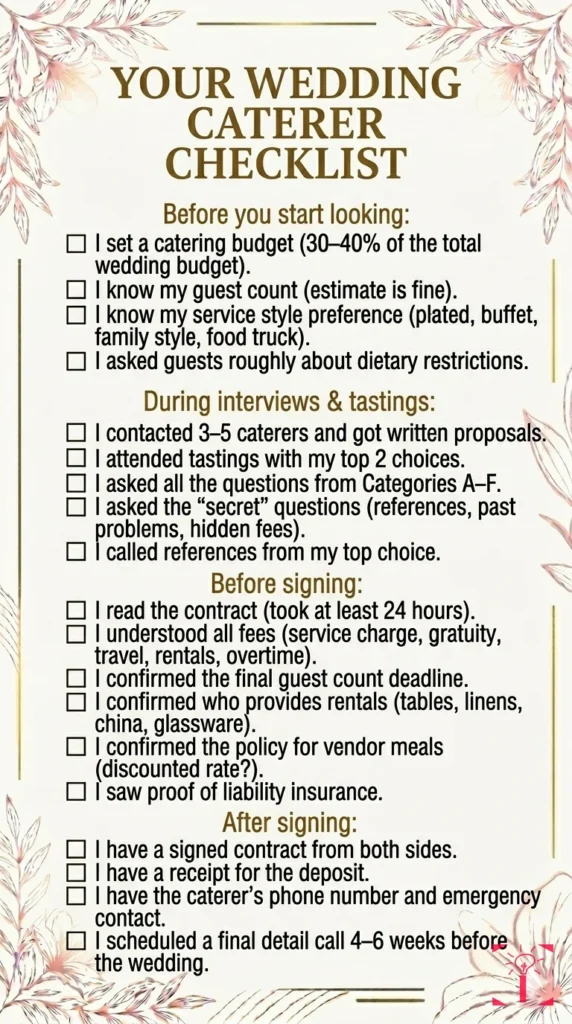
Part 14: Final Checklist (Print This!)
Use this checklist to make sure you haven’t missed anything.
Part 15: Quick Reference Card – 10 Easy Questions to Ask Any Wedding Caterer
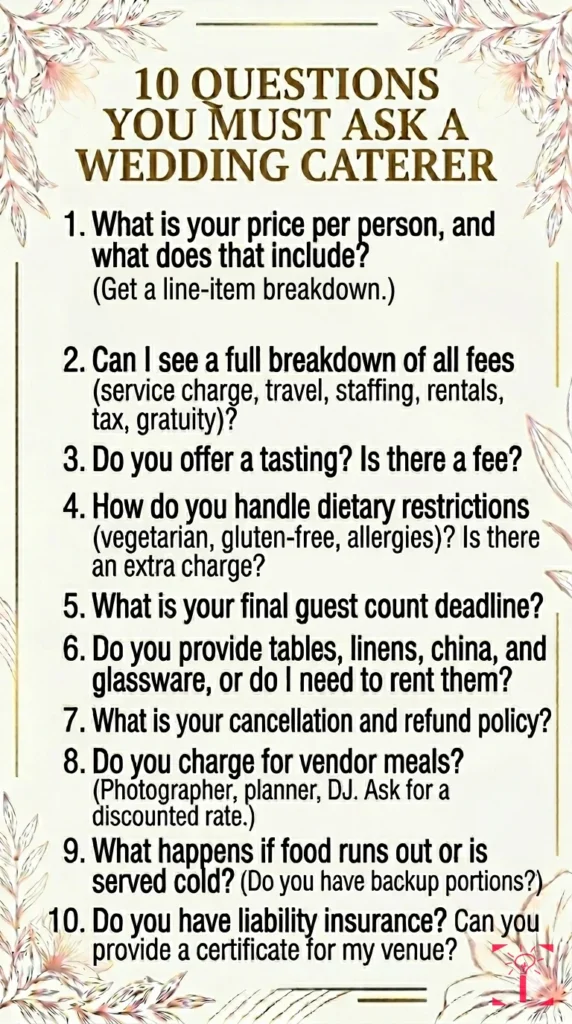
Cut this out or save it on your phone.
Good food doesn’t just fill plates; it shapes how your entire wedding is remembered. When you understand the details, the decisions stop feeling overwhelming and start feeling natural.
Plan it well, and it becomes one of the easiest “yes, that was worth it” moments of your day.
Congratulations, and happy trails!