
The Complete Guide To Choosing Your Wedding Vendors
Your wedding day should be one of the most beautiful days of your life, and if you are anything like me, that’s the one day I want to feel like I have my shit together.
This will happen only when a dozen moving parts are doing their job exactly right. The food arrives on time, the music flows, the photos get captured, and the flowers show up where they’re supposed to. None of that happens by accident. It happens because the right people are behind it.
And when the wrong people are involved? That’s when things slip. Late arrivals. Missed moments. Food that doesn’t quite land. The kind of issues that don’t show up in photos, but definitely will haunt you for the next 8 years.
If you ask me, choosing vendors isn’t luck. It’s a process.
A repeatable, practical, “you can apply this to anything” kind of process, whether you’re hiring a caterer, a photographer, or a DJ. Once you understand how it works, the decisions get clearer, the comparisons get easier, and everything will be stress-free.
That’s exactly what this guide is here to do.
I’ll walk through where to actually find good vendors (not just the loudest ones online), what to ask before you commit, how to spot red flags early, how to compare quotes without getting confused, what those contracts really mean, and how to manage everything once you’ve booked.
No guesswork. No second-guessing. No breakdowns when in this house, bestie!
Step 1: First, Understand the Types of Wedding Vendors (And When to Book Them)
Not all vendors need to be booked at the same time. Some are in high demand and need to be secured a year or more in advance. Others can wait until a few months before.
Typical Booking Timeline
| Time Before Wedding | Vendors to Book |
|---|---|
| 12+ months | Venue, wedding planner, photographer, videographer, caterer |
| 8–10 months | Band or DJ, florist, officiant, rental companies (tables, chairs, linens) |
| 6–8 months | Hair & makeup artist, baker (cake), transportation (shuttles, limo) |
| 4–6 months | Invitation designer, hotel room blocks, rehearsal dinner venue |
| 2–4 months | Lighting designer, photo booth, specialty rentals (lounge furniture, draping) |
Must‑Have vs. Nice‑to‑Have Vendors
- Essential (do not skip): Venue, caterer (or food provider), photographer, officiant.
- Highly recommended (worth the money): Wedding planner/coordinator, DJ or band, florist (at least a bouquet), baker (cake or dessert).
- Optional (nice if budget allows): Videographer, photo booth, lighting designer, lounge rentals, calligrapher, live painter.
Knowing this timeline helps you avoid last‑minute scrambling and ensures you get your top choices.
Step 2: Know Your Budget and Non‑Negotiables Before You Look
Before you email a single vendor, get clear on two things: how much you can spend and what you absolutely must have.
Set a Realistic Vendor Budget (Per Category)
Use the percentage guide from the wedding budget article. Here’s a quick refresher for a $20,000 wedding:
| Category | Percentage | Dollar Amount |
|---|---|---|
| Venue & catering (including bar) | 40–50% | $8,000–$10,000 |
| Photography & videography | 10–15% | $2,000–$3,000 |
| Attire & beauty | 5–10% | $1,000–$2,000 |
| Flowers & decor | 8–12% | $1,600–$2,400 |
| Cake/desserts | 5–10% | $1,000–$2,000 |
| Rentals (tables, chairs, linens) | 5–10% | $1,000–$2,000 |
| Wedding planner | 5–10% | $1,000–$2,000 |
| Cake / desserts | 2% | $400 |
| Contingency fund | 5% | $1,000 |
Adjust these numbers based on your total budget and your priorities.
Define Your Must‑Haves for Each Vendor
Before you start researching, write down 2–3 non‑negotiable requirements per vendor type.
Examples:
- Photographer: Must have shot at our venue before. Must include printing rights. Must deliver full gallery within 8 weeks.
- Caterer: Must accommodate vegan and gluten‑free guests. Must provide all tables, linens, and china. Must allow us to bring our own alcohol (corkage fee okay).
- Florist: Must work with our $1,500 budget. Must reuse ceremony flowers at reception. Must deliver by 10 AM.
Keep this list handy. It will help you quickly rule out vendors who can’t meet your needs.
Create a “Vendor Scorecard” Template
You will compare 2–3 vendors per category. Use a simple table like this:
| Criteria | Weight | Vendor A | Vendor B | Vendor C |
|---|---|---|---|---|
| Price (within budget) | 20% | 4 | 5 | 3 |
| References/reviews | 30% | 5 | 4 | 4 |
| Communication | 20% | 4 | 3 | 5 |
| References / reviews | 20% | 5 | 4 | 4 |
| Contract terms | 10% | 3 | 5 | 4 |
| Weighted total | 100% | 4.4 | 4.2 | 4.0 |
The highest score isn’t always the winner, but it helps you decide.
Step 3: Where to Find Vendors (Best Sources)
Not all sources are equal. Some are more reliable than others.
Reliable Sources (Start Here)
- Your venue’s preferred vendor list. Venues only recommend vendors they trust. These vendors already know the space, which saves you time.
- Your wedding planner’s recommendations. Planners work with vendors every weekend. They know who is reliable and who isn’t.
- Real wedding galleries on Wedding Wire, The Knot, or Green Wedding Shoes. These are real couples, not ads.
- Instagram. Search “[your city] wedding photographer” or “[your city] wedding caterer.” Look at tagged photos, not just the vendor’s own feed.
- Local Facebook wedding groups. Join a group for your area and search for vendor names. Ask for recent experiences.
- Friends and family. Personal recommendations are gold, but remember that your taste might differ.
Sources to Use with Caution
- Google Ads. Anyone can pay to be at the top. It doesn’t mean they’re good.
- Generic directories without reviews. A list of names with no feedback is useless.
- Social media influencers. Many are not local, not available, or very expensive.
Step 4: The Initial Outreach – What to Say and Ask For
First impressions matter. Send a clear, concise message that includes all the information a vendor needs to give you a useful answer.
Template Message for Any Vendor
“Hi [name], We are getting married on [date] at [venue] with about [guest count]. We are looking for [service – e.g., photography for 8 hours]. Our budget is [$X]. Are you available? Could you share your pricing guide and a link to recent work?”
What to Request in the First Email
- Availability – Do they have your date open?
- Pricing guide or package menu – Not just “starting at,” but actual numbers.
- Portfolio or gallery – For photographers, ask for 2–3 full weddings. For caterers, ask for a sample menu with prices.
- Any minimums – Florists often have minimum orders ($1,500+). Caterers may have a minimum guest count (e.g., 75 people).
How Many Vendors to Contact
Aim for 3–5 per category. More than that leads to decision paralysis. Less than that and you might miss a better option. A sweet spot is thus contacting 3-5 vendors.
Step 5: The Vendor Interview – Universal Questions (For Any Type)
These questions work for photographers, caterers, florists, DJs, planners, or any vendor. Customize slightly for the category, but the crux is the same.
A. Experience & Logistics
- How many weddings have you done in the past year? (Look for at least 20–30 for pros.)
- Have you worked at my venue before? If not, will you visit or research it?
- Do you have backup equipment or staff in case of an emergency? (Yes is the only acceptable answer.)
- What is your backup plan if you are sick or unable to attend? (They should have a trusted associate on call.)
- Do you have liability insurance? Can you provide a certificate for my venue? (Non‑negotiable for caterers, transportation, and any vendor working on site.)
B. Pricing & Inclusions
- What is your total fee, and what exactly is included? Get a line‑item breakdown.
- Are there any extra fees I should know about? (Travel, overtime, setup/cleanup, tax, service charge, parking, delivery.)
- What is the deposit amount? Is it refundable? (Usually 25–50%, non‑refundable.)
- When is the final payment due? (Often 1–2 weeks before the wedding.)
- What is your cancellation and refund policy? (Both if you cancel and if they cancel.)
C. Communication & Process
- How quickly do you reply to emails or texts? (Within 24 hours is good.)
- How many in‑person or video meetings are included?
- Will you be the one working my wedding, or an associate/team member? (If an associate, ask to meet them.)
- Do you provide a written contract? (If no, walk away immediately.)
D. References & Reputation
- Can I speak to 2–3 recent couples you’ve worked with?
- Can I see recent reviews from the past 6 months? (Check Google, Wedding Wire, The Knot on your own.)
- Have you ever had a complaint or issue? How did you resolve it? (Honest answer shows integrity.)
Step 6: Category‑Specific Questions (Quick Reference)
Here are a few extra questions for the most common vendor types.
Photographer / Videographer
- Can I see 3 full wedding galleries (not just the highlight reel)?
- What is the turnaround time for sneak peeks and the full gallery?
- Do I get printing rights? Do I get RAW files? (Usually no to RAW, but that’s fine.)
- What happens if your camera breaks during our wedding? (Backup equipment.)
Caterer
- Can you accommodate dietary restrictions (vegan, gluten‑free, allergies)? Is there an extra charge?
- What is your price per person, including tax, service charge, and gratuity?
- Do you provide tables, linens, china, glassware, and flatware? If not, who does?
- What is your final guest count deadline? (Usually 7–14 days before.)
Florist
- What flowers are in season on my date? (In‑season is cheaper.)
- Do you have a minimum order amount? (Many do – $1,000–$2,500.)
- Do you provide vases, delivery, and setup? Is pickup included?
- Can you reuse ceremony flowers at the reception to save money?
DJ / Band
- Do you take requests? Can we give a do‑not‑play list?
- What is your backup plan if your sound equipment fails?
- Will you emcee the reception? Do you provide a written timeline?
- How many hours of performance are included? What is your overtime rate?
Hair & Makeup Artist
- Do you offer a trial? Is it included or extra?
- How long does hair and makeup take per person? (Bride: 60–90 min; each bridesmaid: 30–45 min.)
- Do you travel to the venue? Is there a travel fee?
- Can I see a portfolio with diverse skin tones and hair types?
Wedding Planner
- What type of planning do you offer (full, partial, month‑of)?
- Will you attend vendor meetings with us?
- Do you handle budget tracking and contract review?
- What is your backup plan if you are sick on the wedding day?
We have also created specific guides for you to hire vendors:
- How to Finalize Your Wedding Venue (Including Every Question You Need to Ask)
- How to finalize your wedding photographer (Including Questions to ask the photographer)
- How to finalize your wedding caterer (Questions to ask a wedding caterer)
- How to finalize your florist (Questions to ask a wedding floral designer)
- How to finalize your wedding planner ( Including Questions to ask a wedding planner)
- How to finalize your Cake designer (Questions to ask the cake designer)
Step 7: Red Flags – When to Walk Away
Trust your gut. If something feels off, it probably is. Instincts won’t lie.
Universal Red Flags (Any Vendor)
- No written contract or refuses to show one before deposit.
- Requires full payment upfront (deposit only, never 100% before the wedding).
- Can’t give recent references or has no recent reviews.
- Vague about pricing or adds hidden fees at the end.
- Takes more than 3–4 days to reply to an initial inquiry (during off‑peak season).
- No liability insurance (especially for caterers, transportation, and venues).
Category‑Specific Red Flags
| Vendor | Red Flag |
|---|---|
| Photographer | Won’t show a full gallery; no backup equipment. |
| Caterer | Won’t do a tasting; unclear about service charge or gratuity. |
| Florist | No portfolio; can’t name in‑season flowers. |
| DJ | No backup plan; refuses a do‑not‑play list. |
| Hair/Makeup | No trial option; no portfolio for your skin/hair type. |
If you see any of these, thank the vendor for their time and move on. There are plenty of great vendors out there.
Step 8: Check References – What to Ask Past Couples
A vendor’s website will only show their best work. References tell you the truth.
Script for Calling References
“Hi [name], [Vendor] gave you as a reference. Do you have a few minutes to answer 4 quick questions?”
Then ask:
- Did the vendor show up on time and prepared?
- Was the final product (photos, food, flowers, etc.) what you expected?
- Were there any issues? How were they handled?
- Would you hire them again?
Where to Find Honest Reviews Beyond the Vendor’s Website
- Google Maps (look for 3‑star and 4‑star reviews because they’re often the most honest).
- Wedding Wire, The Knot, Yelp (sort by “most recent”).
- Reddit – r/weddingplanning search the vendor name.
- Local Facebook wedding groups – search and ask.
Step 9: Compare Vendors Using a Scorecard
You’ve gathered proposals, asked questions, and checked references. Now, for the fun part, it’s time to decide.
Sample Scorecard (Fill in Your Own Numbers)
| Criteria | Weight | Venue A | Venue B |
|---|---|---|---|
| Price (within budget) | 20% | 4 | 5 |
| References/reviews | 30% | 5 | 4 |
| Communication | 20% | 4 | 3 |
| References / reviews | 20% | 5 | 4 |
| Contract terms | 10% | 3 | 5 |
| Weighted total | 100% | 4.4 | 4.2 |
The Tie‑Breaker: Gut Feeling and Chemistry
If scores are close, ask yourself:
- Who made me feel calm and understood?
- Who answered all my questions without rushing or getting defensive?
- Who seemed genuinely excited about our wedding?
You will spend a lot of time with your photographer, planner, and DJ. Chemistry matters, I mean it when I say this.
Step 10: The Contract – What Every Wedding Vendor Contract Must Include
Never sign a contract without reading every word. Take at least 24 hours. If something is unclear, ask for clarification in writing.
Universal Contract Clauses (For Any Vendor)
- Full names of both parties, wedding date, and venue address.
- Scope of work – a detailed list of services, items, hours, and deliverables.
- Payment schedule – deposit amount, interim payments, final due date.
- Cancellation policy – what you lose if you cancel; what happens if they cancel (full refund + help finding replacement).
- Substitution clause – can they send an associate? Do you get to approve that person?
- Overtime / additional fees – hourly rate, travel, parking, etc.
- Liability and insurance – vendor must provide a certificate naming you or your venue as additionally insured.
- Force majeure – what happens if the wedding is canceled due to weather, pandemic, or natural disaster? (Read this carefully because some contracts give no refund.)
Category‑Specific Contract Clauses
| Vendor | Extra Clause to Check |
|---|---|
| Caterer | Final guest count deadline, service charge %, gratuity %, food allergy disclaimer. |
| Photographer | Delivery deadline (specific week), printing rights, RAW file policy. |
| Florist | Substitution policy for out‑of‑season flowers, delivery window (e.g., “by 10 AM”). |
| DJ | Playlist approval, do‑not‑play list, sound level limits (if venue has noise rules). |
Never Sign Without Reading – Even If It’s Long
If a vendor pressures you to sign immediately, that’s a red flag. A good vendor will give you time. Ask for changes in writing before signing. Most reasonable requests will be accepted. If not, you know the drill.
Step 11: Managing Your Vendors After Booking
You’ve signed contracts and paid deposits. The work isn’t over (sorry, not sorry) but it gets easier.
Create a Vendor Contact Sheet
Share this with your planner or a trusted point person. Use a simple table:
| Vendor | Contact Person | Phone | Deposit Paid | Balance Due | Due Date | |
|---|---|---|---|---|---|---|
| Venue | Jane Smith | 555-1234 | [email protected] | $2,000 | $6,000 | May 1 |
| Caterer | Tom Jones | 555-5678 | [email protected] | $1,500 | $4,500 | April 15 |
| Photographer | Alex Lee | 555-9012 | [email protected] | $1,000 | $2,500 | April 30 |
Build a Wedding Day Timeline and Share It
About 4–6 weeks before the wedding, create a timeline that includes:
- Vendor arrival times
- Setup locations
- Meal times for vendors (if they need a meal)
- Breakdown and pickup times
Email this timeline to every vendor. Then call or text to confirm they received it.
Final Confirmations (Week of Wedding)
Send a short message to each vendor:
“Hi [name], just confirming everything is still on track for [date] at [time] at [venue]. Please reply to confirm. Thank you!”
Also, confirm the day‑of contact person (planner, maid of honor, or family member) and give that person’s phone number to every vendor.
Payment Reminders
Set calendar alerts 1 month and 1 week before each payment due date. Do not rely on memory.
Step 12: Vendor Tips – When and How Much
Tipping can be confusing. I’ve created this simple guide.
Who to Tip (And Who Not To)
| Vendor | Tip? | Typical Amount |
|---|---|---|
| Hair & makeup artist | Yes | 15–20% of service |
| Delivery people (flowers, cake, rentals) | Yes | $5–$10 per person |
| Servers, bartenders | Often included in service charge – check contract | If not, 15–20% of food/drink bill |
| Photographer | Optional, not required | $50–$200 if they were exceptional |
| DJ / band | Optional | $50–$150 per person |
| Florist | Optional, not expected | $50–$100 if they went above and beyond |
| Business owners (planner, caterer owner, venue owner) | No | They set their own prices |
How to Tip
- Cash in a labeled envelope given to your planner or a trusted person. Write the vendor’s name and amount on the outside.
- Or add to the final payment. Ask the vendor if they accept tips via credit card or check.
Prepare the envelopes the week before the wedding. You’ll be glad you did.
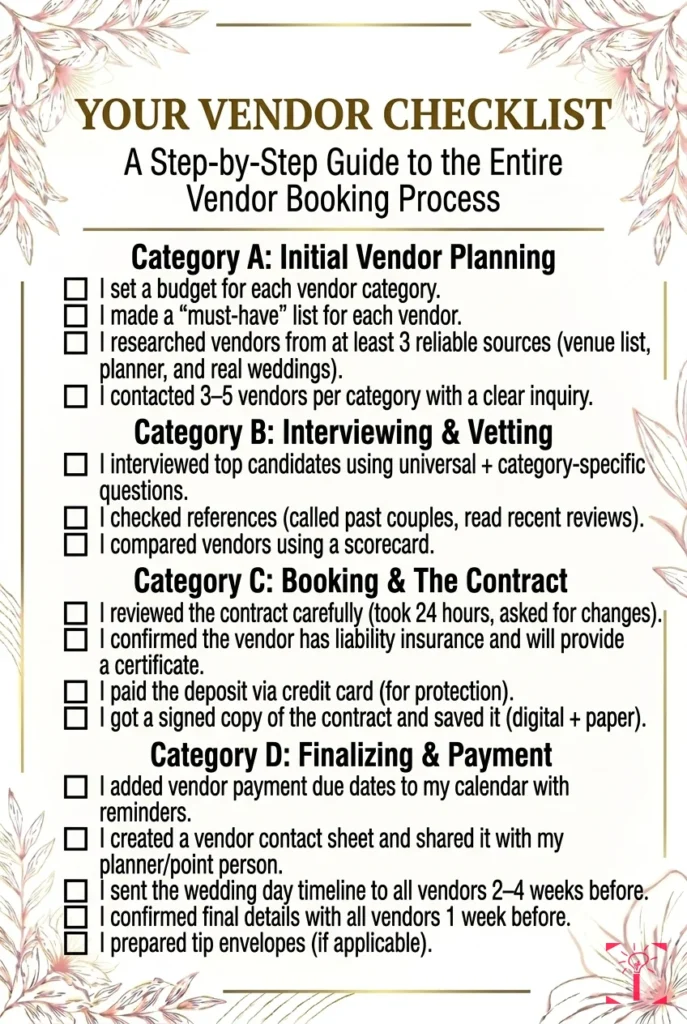
Final Checklist – Choosing Your Wedding Vendors (Print This!)
Use this checklist to make sure you haven’t missed anything.
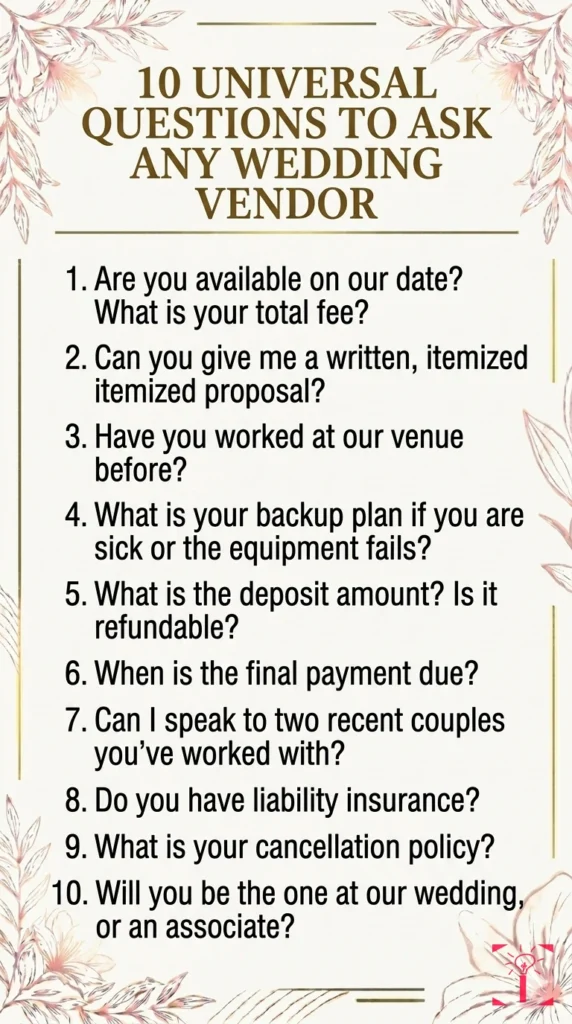
Quick Reference Card – 10 Universal Questions to Ask Any Wedding Vendor
Save this on pinterest or print it out.
You Are Now a Vendor‑Hiring Expert, Hooray!
Great vendors don’t just deliver services; they quietly hold your entire day together like heroes without a cape. Choose them well, and everything else falls into place exactly as it should.
Congratulations and happy trails!
