
How To Decide Your Wedding Budget
Nobody gets engaged and thinks, “Oh, spreadsheet, exciting.”
But here’s what happens without one. You say yes to a few things you love, yes to a few things that seem reasonable, yes to a few upgrades that feel worth it in the moment, and then somewhere around month four of planning, you add it all up and have a quiet crisis in your kitchen at 11 pm.
Every couple who has ever overspent on a wedding will tell you the same thing. It didn’t happen all at once. It happened one completely justifiable decision at a time.
A Budget isn’t the thing that stops you from having the wedding you want. It’s the thing that makes it possible. When you know exactly what you’re working with, you stop second-guessing every decision and start making them confidently.
You say yes to the things that genuinely matter to you. You say no to the things that don’t without an ounce of guilt. No surprise invoices. No “how did we spend that much” conversations. No debt follows you into the marriage like an uninvited guest.
This guide walks you through every single step. From figuring out what you can actually afford, dividing it across categories in a way that makes sense, to tracking every dollar without losing your mind, and handling the unexpected costs that show up in every wedding budget, whether you plan for them or not.
Romantic? Maybe not. Worth it? Absolutely. Let’s talk money.

Get our FREE wedding budget worksheet, which will help you plan your budget step by step as you read this article. Let’s get started.
Step 1: First, Understand What a Wedding Budget Really Covers
A wedding budget is not just “the venue and the food.” There are dozens of categories. If you forget one, you’ll be shocked when the bill shows up.
Here is the complete list of what you need to budget for (the non-negotiables list):
| Category | What it Includes |
|---|---|
| Venue & Rentals | Ceremony and reception space; tables, chairs, linens, lighting, sound equipment, dance floor |
| Catering & Bar | Food, drinks, serving staff, service charges, gratuity, corkage fees |
| Photography & Videography | Engagement shoot, wedding day coverage, albums, raw footage |
| Attire | Wedding dress, suit, shoes, veil, jewelry, alterations |
| Flowers & Decor | Bouquets, boutonnieres, centerpieces, ceremony decor, arch flowers |
| Music | DJ, band, ceremony musicians, sound equipment |
| Rings | Engagement ring (if not already bought), wedding bands |
| Invitations & Stationery | Save-the-dates, invitations, RSVP cards, thank-you cards, postage |
| Transportation | Guest shuttles, couple’s car (limo, vintage car, ride credits) |
| Hair & Makeup | Trial session, day-of styling for bride and bridesmaids |
| Wedding Planner/Coordinator | Full planning, partial planning, or month-of coordination |
| Cake or Desserts | Wedding cake, cupcakes, dessert bar |
| Gifts | Bridal party gifts, parents’ gifts, gifts for each other |
| Officiant Fee | Honorarium for the person officiating the ceremony |
| Marriage License | Legal fee required by the local authority |
| Rehearsal Dinner | Pre-wedding dinner, often separately budgeted |
| Honeymoon | Travel and stay expenses (optional inclusion in wedding budget) |
| Contingency Fund | 5–10% of the total budget is reserved for unexpected expenses |
That looks like a lot. Don’t panic. You don’t have to spend on every category. But you need to know they exist, so nothing sneaks up on you.
Step 2: Have the Money Talk (Just the Two of You)
Before you look at a single venue or dress, sit down with your partner. No phones. No distractions. This is the most important conversation you will have about the wedding.
Be Honest About Your Individual Finances
- What do you have in savings that you’re willing to use for the wedding? (Not your emergency fund – that’s off limits.)
- What is your monthly income after bills and living expenses?
- Do you have any debt (credit cards, student loans, car payments)? How much are you comfortable adding?
- How much can you realistically save each month between now and the wedding?
Answer Three Questions as a Couple
- How much do we have in savings that we are willing to use for the wedding? (Example: $10,000)
- How much can we save per month between now and the wedding? (Example: $1,000 per month for 12 months = $12,000)
- Are parents or family contributing? If yes, get exact numbers, not “we’ll help a little.” Ask for a specific amount.
Decide on a Total Number
Add up savings + monthly savings + family contributions. That’s your total wedding budget. Write it down. Example: $10,000 + $12,000 + $5,000 = $27,000.
Even a rough range is fine, like $25,000–$30,000. You can refine later.
Step 3: Get Clear on Who Is Paying for What
Old etiquette said the bride’s parents paid for most of the wedding. That’s not how it works for most couples anymore. Today, couples often pay for their own wedding, or they split costs with both families.
Create a “Who Pays” List
Be very specific. Example:
- Couple pays: Venue, catering, photography, attire, flowers, and honeymoon.
- Bride’s parents pay: Rehearsal dinner, officiant, and marriage license.
- Groom’s parents pay: Alcohol, DJ, transportation.
- Or everyone puts money into one shared pot, which is simpler, but you need to agree on how decisions are made.
Get Cash in Hand Before You Book Anything
A promise is not a check. Family members mean well, but life happens. Ask them to transfer the money or write a check before you sign any contracts. If they can’t pay until later, do not count that money in your budget. Only budget money you already have or know you will save yourself.
Step 4: Estimate Your Guest Count First (It Drives Everything)
Your guest count is the single biggest factor in your budget. More people means more food, more drinks, more tables, more chairs, more linens, more invitations, more favors, more everything.
Get your FREE guest list planner.
Make an A, B, C List
- A list: Must‑invite (immediate family, closest friends). Usually 20–50 people.
- B list: Would‑like‑to‑invite (extended family, good friends). Another 20–50.
- C list: Nice‑to‑invite (coworkers, distant relatives, plus‑ones of single friends). Another 20–50.
Get a Realistic Number
Don’t start with your dream guest count. Start with your venue capacity and your budget. If your venue holds 150 and your budget can feed 100, you need a smaller guest list.
Rule of thumb: 80–90% of invited guests usually attend. But budget for 100% just in case. It’s better to have a little extra than to be short.
Step 5: Research Real Costs in Your Area (Don’t Guess)
The average wedding in the US costs around $30,000. But that number is meaningless if you live in a small town vs. New York City. A $30,000 wedding in Manhattan might be a backyard BBQ. In rural Ohio, it’s a ballroom affair. Do your research, guys, I always insist.
How to Research Real Costs
- Look at real wedding recaps on Reddit (r/weddingplanning) and budget breakdowns on Wedding Wire or The Knot. Search for weddings in your city or a similar city.
- Ask recently married friends for their actual budgets, not what they told their parents, but what they really spent.
- Get 2–3 quotes from venues and caterers. They will give you real numbers for free. Just send an email or fill out their contact form.
Create a “Cost Reality” List
Example for a mid‑sized city (not NYC, not rural):
- Catering: $40–$80 per person (food only; add bar, tax, service charge)
- Photography: $2,500–$5,000
- Flowers: $1,500–$3,000
- DJ: $1,000–$2,000
- Venue rental: $2,000–$6,000 (some include tables/chairs, some don’t)
- Wedding dress: $1,000–$2,500 (plus alterations $200–$600)
Write down the range for each category. This will stop you from dreaming about a $10,000 photographer when your whole budget is $15,000.
Go through our Complete Guide To Choosing Your Wedding Vendors to finalize the best vendors in your budget.
Step 6: Use a Budget Breakdown Percentage Guide (Starting Point)
Percentages help you avoid spending 50% of your budget on flowers and having nothing left for food. Use this as a starting point, then adjust based on your priorities.
Sample Percentage Breakdown for a $20,000 Wedding
| Category | Percentage | Dollar Amount |
|---|---|---|
| Venue & catering (including bar) | 40–50% | $8,000–$10,000 |
| Photography & videography | 10–15% | $2,000–$3,000 |
| Attire & beauty | 5–10% | $1,000–$2,000 |
| Flowers & decor | 8–12% | $1,600–$2,400 |
| Cake/desserts | 5–10% | $1,000–$2,000 |
| Rentals (tables, chairs, linens, lighting) | 5–10% | $1,000–$2,000 |
| Invitations & stationery | 2–3% | $400–$600 |
| Wedding planner | 5–10% | $1,000–$2,000 |
| Cake / desserts | 2% | $400 |
| Gifts, favors, transportation, misc | 5% | $1,000 |
| Contingency fund (5%) | 5% | $1,000 |
Add it up: 100% = $20,000.
If Your Budget Is Smaller (e.g., $10,000)
Shift percentages. Spend less on attire, flowers, stationery, and a planner. Spend more on venue/catering and photography (those matter most to guests). Example: 50% on venue & catering ($5,000), 15% on photography ($1,500), 10% on attire ($1,000), and cut the rest.
Step 7: Identify Your Top 3 Priorities (The “Non‑Negotiable Splurge”)
You cannot spend top dollar on everything. So decide what matters most to you as a couple.
Each Partner Picks 1–3 Things
- Partner A: “Great food, live band, good photographer.”
- Partner B: “Beautiful venue, open bar, relaxed guest experience.”
Combine and Rank
Together, pick your top 3 priorities. Example:
- Food & bar (amazing meal, open bar)
- Photography (capture everything perfectly)
- Venue (stunning location)
Budget Accordingly
For your top 3 priorities, budget at or above the average in your area. For everything else, budget below average or cut entirely.
Example: If photography is #1, spend $4,000 instead of $2,500. Cut back on flowers (skip centerpieces, use greenery). Downgrade the limo. Skip favors.
This is the secret to a happy budget. Splurge where you care, save where you don’t.
Step 8: Build Your Actual Budget Spreadsheet
You need one place to track everything. Do not keep numbers in your head or on random napkins.
Get our FREE wedding budget planner, which will help you work through your budget.
Or Use
- Google Sheets (free, accessible anywhere)
- Microsoft Excel
Create Columns
Here’s a simple template that I’ve made for you. Customise it based on your preference:
| Category | Estimated | Actual | Deposit Paid | Remaining Due | Vendor | Due Date | Paid? |
|---|---|---|---|---|---|---|---|
| Venue | $5,000 | $5,200 | $1,000 | $4,200 | The Barn | May 1 | Yes (deposit) |
| Catering | $6,000 | ||||||
| Photography | $3,000 | ||||||
| … |
Add a “Contingency” Line
Create a line called “Contingency Fund,” maybe around 5–10% of your total budget. This money sits untouched until a surprise expense pops up (extra postage, last‑minute alterations, a vendor fee you forgot). If you don’t use it, great. Put it toward the honeymoon.
Step 9: Get Real Quotes – Then Adjust
Your estimated budget is just a guess until you get real quotes. Drop that text, get that quote & sit down with accurate estimates.
Contact 2–3 Vendors per Category
Ask for actual pricing, not “starting at.” Send an email: “We have 120 guests on [date] at [venue]. What is your pricing for [service]?”
Compare Quotes to Your Estimates
If catering quotes are $10,000 but you budgeted $6,000, you have three choices:
- Increase the total budget (if you have the money).
- Cut somewhere else (cheaper flowers, no videographer, fewer guests).
- Change the plan (plated dinner → buffet; prime rib → chicken; open bar → beer & wine only).
Do Not Book Anything Until Your Budget Is Realistic
It’s very common to adjust your budget after getting quotes. That’s fine. Just do it before you sign contracts, not after. (or it’s gonna be messy)
Step 10: Cut Costs Without Ruining Your Day (The Smart Way)
You can save thousands of dollars on things guests will never notice. Here’s how you do that smartly.
Ways to Save That Guests Never Notice (Safe)
- Skip favors. Most guests leave them on the table.
- Buy a sample or pre‑owned dress. Still beautiful, half the price.
- Use digital save‑the‑dates. Email or a free website (With Joy, Zola).
- Have a lunch or brunch wedding. Food is cheaper, and less alcohol is consumed.
- Limit the bar to beer, wine, and one signature cocktail. No full liquor bar.
- Skip the late‑night snack. Guests are full from dinner and cake.
- Use in‑season flowers and more greenery. Greenery is cheap.
- Order a small display cake + sheet cake. Guests never know.
- Hire a DJ instead of a band. Much cheaper, takes up less space.
- Get married on a Friday or Sunday. Venues often discount 20–40%.
- Choose a venue that includes tables, chairs, and linens. Saves rental costs.
Ways to Save That Are Risky (Think Twice)
- DIY flowers. Requires skill, fridge space, and a lot of time. Very stressful, I’m warning you.
- Ask a friend to be the photographer. High risk of bad photos and hurt feelings.
- Cutting the guest list drastically. Can hurt family relationships. Be careful.
Step 11: Track Every Dollar – And Update Weekly
A budget only works if you actually track it.
Set Up a Weekly Budget Check
Every Sunday, spend 15 minutes updating your spreadsheet. Log every expense from the past week.
Compare Actual vs. Estimated
If you overspent on flowers, underspend on something else. Example: Flowers went $200 over, so take $200 out of the “decor” line (skip the fancy cake topper, use fewer candles).
Keep Receipts and Contracts in One Folder
Digital folder (Google Drive) or physical binder. (Now you know why Amy Santiago pulled a Wedding binder in Brooklyn 99) You will need them for payments and disputes.
Step 12: Plan for Hidden Costs (The Ones Couples Forget)
These are the expenses that blindside couples. Do not ignore them.
Common Hidden Costs
| Expense | Details / Typical Cost |
|---|---|
| Taxes | Sales tax on catering, rentals, etc. (usually ~7–10% extra) |
| Service Charge | Typically 18–22% on catering; check if gratuity is included |
| Delivery & Setup Fees | Extra charges if the photographer, DJ, or venue runs late |
| Overtime Fees | Extra charges if photographer, DJ, or venue runs late |
| Corkage Fee | $5–$15 per bottle if bringing your own alcohol |
| Alterations | Wedding dress alterations (~$200–$600) |
| Marriage License | Legal fee (~$30–$150 depending on location) |
| Overnight Shipping | For last-minute invitations or items |
| Tips | ~15–20% for hair/makeup, DJ, delivery staff (confirm contracts) |
| Postage | Invitations and thank-you cards (can exceed $100) |
| Parking | Charges for guests or vendors at certain venues |
| Bathroom Trailer | Needed for outdoor venues without restrooms |
| Generator | Required for outdoor setups (lighting, music, catering) |
Add a “Miscellaneous” Line
At least $500–$1,000 for things you can’t predict. You will use it. Trust me!
Step 13: Create a Payment Schedule So You’re Never Surprised
Vendors require deposits and final payments on specific dates. If you miss a payment, you could lose the vendor.
List All Payment Due Dates
Go through each contract and write down:
- Deposit amount and due date (often 25–50% at booking)
- Midway payment (sometimes)
- Final payment due date (often 1–2 weeks before the wedding)
Put Them on a Calendar
Google Calendar, a paper planner, or your spreadsheet. Add reminders 1 month before each due date.
Work Backward
If the final payment is due 2 weeks before the wedding, make sure that the money is in your account 3 weeks before. Do not rely on a paycheck that arrives the day before.
Step 14: Communicate Your Budget to Vendors (Be Honest)
Many couples are shy about their budget. Don’t be. Vendors would rather know upfront than waste time showing you things you can’t afford. It’s an awkward talk, but do it.
When You Contact a Vendor, Say Your Budget
Example: “Our total budget for flowers is $1,500. Can you work with that?”
Example: “We have $4,000 for photography. What can you offer in that range?”
If a Vendor Says No, Thank Them and Move On
Do not fall in love with a vendor who is out of your budget. There are plenty of great options at every price point.
Ask: “What Can We Do to Stay Within $X?”
Good vendors will offer solutions: “Use fewer flowers,” “Skip the second shooter,” “Come for 6 hours instead of 8.”
Step 15: Handle Unexpected Expenses Without Panic
Something will go over budget. It always does. That’s why you have a contingency fund.
If You Run Out of Contingency
Look at your priority list. Find a non‑priority to cut or reduce:
- Reduce guest count by 5–10 people.
- Skip the photo booth.
- Downgrade the limo to ride credits.
- Cancel the videographer (if it wasn’t a top priority).
Do Not Put Wedding Expenses on a Credit Card (Unless You Can Pay It Off Immediately)
Interest charges can add thousands of dollars to your wedding. If you must use a card, pay it off within the month. Otherwise, cut something.
Step 16: Final Budget Review – One Month Before the Wedding
One month out, most payments are done. Do a final check.
Create a “Day‑Of” Cash Envelope
Put $300–$500 in cash in an envelope. Label it “Tips & Emergencies.” Give it to a trusted person (planner, maid of honor). This covers last‑minute tips, a missing vendor, or a small emergency.
Confirm Payments with Vendors
Email or call each vendor: “Just confirming that our final payment of $X was received on [date]. Thank you!”
Do a Final Budget Check
Add up your actual spending. Compare to your original estimate. If you’re over, don’t beat yourself up. Most couples go over by 10–20%. Learn for next time (or for future financial planning).
Common Budget Mistakes to Avoid
Learn from others so you don’t make the same errors.
| Mistake | Why It Hurts |
|---|---|
| No contingency fund | A $500 surprise becomes a crisis. |
| The venue is cheap, but their required caterer is expensive. | Venue is cheap, but their required caterer is expensive. |
| Forgetting tax and service charges | A $10,000 catering quote becomes $13,000. |
| Paying for things you don’t care about | Elaborate favors, expensive signage, fancy napkin folds – skip them. |
| Letting family pressure you into more guests | Each extra guest costs $50–$150. “If you want Aunt Sue, that’s $75 from your gift to us.” |
| Not tracking small purchases | $20 here, $50 there adds up fast. Track everything. |
Final Checklist – Deciding Your Wedding Budget (Save This!)
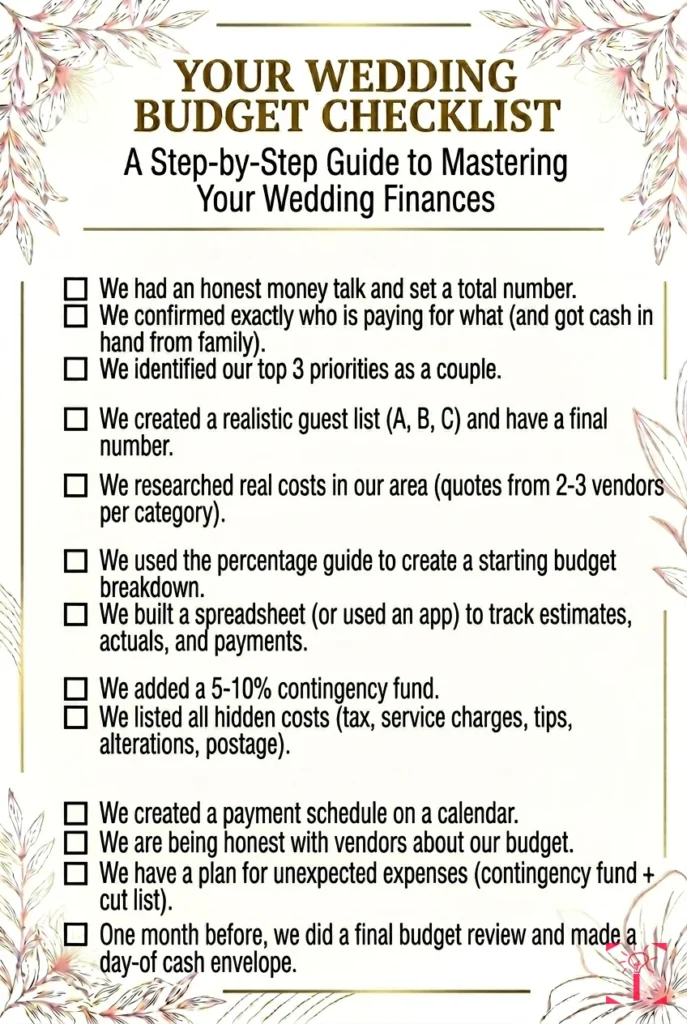
5 Questions to Ask Yourself Before Spending
Before you swipe your card, ask these five questions:
- Is this in our top 3 priorities?
- Yes → Spend happily.
- No → Ask the next question.
- Can we get the same effect for half the price?
(e.g., grocery store flowers, digital invites, DIY signage.) - Will guests notice or care?
- If no → Skip or downgrade.
- If yes → Keep it (but only if it’s a priority).
- Does this bring us joy, or are we doing it because we think we “should”?
(Throw out the “shoulds.”) - If we spend this, what are we not spending on?
(Every dollar has a trade‑off. Be intentional.)
A budget is not a restriction. It’s a roadmap. It tells you where you can splurge without guilt and where you can save without worry. With a clear budget, you can book vendors confidently, avoid debt, and enjoy your big day without money stress.
Since we did our homework, now is your time to shine! Go plan a beautiful wedding that only jerks happy tears!
Congratulations and happy planning!
