How to Choose Your Wedding Photographer
Let me paint you a picture, hold up. It’s one year after your wedding, the flowers are long gone, the cake is a memory, and the dress is in a box. The only thing you have left from that day, in full living detail, is your photos.
Which means your photographer might actually be the most important vendor you book. And yet somehow, choosing one feels like trying to find a specific song without knowing the title, the artist, or any of the lyrics.
Hundreds of portfolios that all start looking the same after a while. Prices that appear to have been generated by a random number machine. Contracts written in a language that technically resembles English. And that quiet, persistent fear that you’ll spend a significant amount of money and end up with photos that look nothing like what you imagined. It’s a lot, I know.
The good news is that finding the right wedding photographer is so much simpler once someone walks you through what to actually look for, what to ask, and what the answers should sound like. No fancy jargon, no overwhelm, no guesswork.
That’s exactly what this guide does. By the end of it, you’ll know how to find photographers worth considering, how to compare them without losing your mind, what every contract clause actually means, and the exact questions to ask so nothing important slips through the cracks.
Your photos deserve to be everything. Let’s make sure they are, okay?
Part 1: Before You Even Look at Photographers
Know What You Actually Want
Before you start scrolling Instagram, take 10 minutes to answer these three questions for yourself and your partner:
- What style of photos do you like?
- Candid / documentary means the photographer stays in the background and captures real moments as they happen.
- Posed / traditional means they will tell you where to stand, how to smile, and set up group shots.
- Most photographers do a mix. But one style is usually stronger. Decide what matters to you.
- How do you want the photos to look?
- Light and airy: soft, bright, pastel colors.
- Dark and moody: rich shadows, dramatic feel.
- True to life: colors look exactly like they did on the day.
- Look at full wedding galleries (not just highlight reels) to see if you like their consistent editing.
- What shots are non‑negotiable?
- Make a short list. For example: “Bride + mom getting ready,” “Groom + his brothers,” “A big group shot of all guests.”
- You don’t need 100 items. Ten to fifteen is plenty.
Set a Realistic Budget
Most couples usually spend between 10% and 15% of their total wedding budget on photography. So if your wedding budget is $20,000, expect to spend $2,000–$3,000 on photos. That usually gets you a professional for 6–8 hours, with an online gallery and printing rights.
Cheap photographers (under $1,000) often have little experience, no backup gear, and can cancel at the last minute. Very expensive photographers ($5,000+) are lovely, but not necessary for most weddings. Pick what fits your wallet and your priorities. No low-balling or high-balling.
Remember, your photographer will be next to you for more hours than your spouse on the wedding day. Seriously. They will see you cry, fix your dress, and eat dinner nearby. If you don’t like their personality, the day will feel awkward. So chemistry matters. A lot.
Part 2: How to Find Photographers (And Spot the Bad Ones)
Where to Look
- Google Maps (search “wedding photographer near me”)
- Wedding Wire or The Knot
- Instagram (search your venue name + “wedding”)
- Ask friends who recently got married
- Your venue’s preferred vendor list
What to Ask Right Away
When you find someone you like, hit them up with a short message:
“Hi! Our wedding is [date] at [venue name]. We need about [6 or 8] hours of photography. Our budget is around [$X]. Are you available? Also, can we see 3 complete wedding galleries from past clients?”
That last part is very important. Anyone can post 10 pretty photos. But a full gallery (200–600 images) shows you the truth about how they handle dark churches, rainy outdoor ceremonies, weird lighting, and regular‑looking people.
Red Flags to Watch For
- Inconsistent editing – Some photos are bright, some are dark, and skin tones change from one picture to the next.
- No bad weather photos – If every gallery has perfect sunshine, they may not know how to shoot in rain or shade.
- All photos are of models – Real weddings have real people of all sizes, ages, and skin colors. If you don’t see that, be careful.
- They refuse to show a full gallery – Run the other direction, girl.
Part 3: Before You Call or Meet
Send a Good First Message
You can use this,
“Hi [photographer name],
We love your work! Our wedding is [date] at [venue]. We’re planning on [6] hours of coverage. Our budget is [$2,500]. Are you free that day? If yes, could we hop on a 20‑minute phone or Zoom call this week? Thank you!”
If they are free and in your budget, schedule a call. Zoom is great because you can see their face. Phone is fine too. Coffee meetings are nice, but take more time.
Do Your Homework Before the Call
- Write down your must‑have shots – Example: “Bride + mom getting ready,” “Groom + his dad,” “Whole bridal party laughing.”
- Think about your worries – “I’m shy in front of a camera,” “My family is divorced and awkward,” “Our venue is very dark inside.” Write them down so you don’t forget to ask. I am serious, it might sound weird, but do ask them!
Part 4: The Big Call – Simple Questions to Ask
Take notes during the call. Or ask if you can record it (most will say yes). You will not remember everything otherwise.
Category A: Timing & Schedule
- Do you charge by the hour or a flat day rate? (Most charge a flat rate for 6 or 8 hours, then an hourly overtime fee.)
- How much for extra time? (Ask for a per‑half‑hour rate.)
- Do you need a meal at the wedding? (Yes is normal. They need to eat too.)
- What time will you arrive? (A good answer is roughly around 30–60 minutes before the start time you booked.)
- Do you bring backup cameras and lights? (They must say YES. If a camera breaks, they need another one ready.)
Category B: Who Will Actually Show Up
- Will YOU be the one shooting my wedding, or someone else from your company? (Some big studios send whoever is free. Make sure you are hiring the person you talked to.)
- If I pay for a second shooter, can I see their work first? (Yes, you should approve them.)
- What happens if you get sick on my wedding day? (They should have a written backup plan. Could be another professional photographer on call, or a network of peers who can step in.)
Category C: How They Take Photos
- Do you tell people how to pose, or do you just capture what happens? (Most will give light direction (“stand there, look at each other”) but not stiff posing. That’s usually good.)
- How much time do you need for family group photos? (Ask for a real number. For 10 groupings, 30 minutes is typical. For 20 groupings, you need an hour.)
- Can you help me make a timeline for photos on the wedding day? (A good photographer will say yes. They know how long things take.)
- How do you handle divorced parents or shy family members? (They should have a calm, respectful approach. Listen to their answer, does it feel kind?)
Category D: What You Get After the Wedding
- How many edited photos will I get? (Normal range: 50–80 photos per hour of coverage. So for 8 hours, expect 400–600 photos.)
- Can I print the photos myself? (You want “personal printing rights” in the contract.)
- Will there be a watermark on my photos? (The answer should be NO, never.)
- When will I see a few “sneak peek” photos? (Usually within 1 week. Some do 48 hours.)
- When will I get the full gallery? (6–12 weeks is normal. Get a specific week estimate.)
- Do you make wedding albums? How much extra? (You can always print your own, but albums are nice. Ask for a price list.)
Category E: Money & Paperwork
- How much is the deposit to save my date? (Usually 30% to 50%. The rest is paid later.)
- What is your cancellation policy?
- If you cancel, do you get any money back? (Usually no after a certain date.)
- If they cancel, do you get a full refund? (Yes, and they should help find a replacement.)
- When is the final payment due? (Often 2–4 weeks before the wedding.)
- Is there a travel fee if my venue is far? (Common if the venue is over 30–50 miles from them.)
- Can I see the full contract before I pay anything? (YES. Always say yes to this. If they say no, walk away.)
Part 5: The “Secret” Questions That Reveal Problems
These three questions often show you the truth about a photographer.
Question 1: “Can I talk to two couples you worked with recently?”
- A good photographer will give you names and emails right away.
- If they hesitate or make excuses, that’s a red flag.
Question 2: “Tell me about a wedding that went wrong. What did you do?”
- Everyone has had a bad day (late couple, broken flash, rainstorm).
- A good answer shows honesty and problem‑solving: “The bride’s dress zipper broke. I helped hold a sheet for privacy while her mom fixed it. Then we shifted the timeline.”
- A bad answer: “Nothing ever goes wrong for me.” (That’s a lie, as clear as the day.)
Question 3: “What’s something couples often forget to ask you about?”
- This shows if they are hiding extra fees or problems.
- A good answer: “Parking fees at the venue,” or “If you want photos of every table setting, tell me ahead of time.”
- A suspicious answer: “I can’t think of anything.” (Then later, they surprise you with extra costs.)
Part 6: How to Compare Two or Three Photographers
By now, you should have 2 or 3 finalists. Don’t look at more than that because it gets confusing.
Make a Simple Scorecard
Use a notebook or a note on your phone. Give each photographer a score from 1 to 5 in these four areas:
| Area | Weight | Photographer A | Photographer B |
|---|---|---|---|
| Style (do you love their photos?) | 40% | ||
| Price (fits your budget?) | 20% | ||
| Personality (did you feel comfortable?) | 30% | ||
| Logistics (timing, backup plan, contract) | 10% |
Multiply the score by the weight. Add up the total.
Example:
Style = 5 out of 5 → 5 × 0.4 = 2.0 points
Price = 3 out of 5 → 3 × 0.2 = 0.6 points
Personality = 5 out of 5 → 5 × 0.3 = 1.5 points
Logistics = 4 out of 5 → 4 × 0.1 = 0.4 points
Total = 4.5 out of 5
The Tie‑Breaker
If scores are close, trust your gut. Which person made you feel calm? Which one answered your questions without rushing? You cannot buy good chemistry. Pick the human you want next to you on your wedding day.
Part 7: The Contract – (Read This Carefully, I Repeat)
Once you pick a photographer, they will send a contract. Do not sign it in 5 minutes. Take at least 24 hours.
7 Things to Look For in Every Contract
- The deposit amount and cancellation policy – How much do you lose if you cancel? (This is normal, just know the number.)
- Substitution clause – Can they send a different photographer without asking you? Look for wording like “may substitute with another associate.” You want the right to approve any replacement.
- Delivery deadline – Does it say “on or before 10 weeks after the wedding”? If it says “as soon as possible,” that’s too vague. Ask for a real date.
- Model release – This says they can use your photos on their website or social media. You can say yes or no. If you say no, they might charge extra or not work with you. That’s okay, you decide what you’re comfortable with.
- Gallery expiration – How long do you have to download all your photos? Never agree to less than 30 days. 90 days is better.
- Travel and parking – Is there a cap? Example: “Client pays actual parking fees, not to exceed $50.” If it’s open‑ended, you could get a surprise bill.
- Arbitration or court – If there’s a fight, where do you resolve it? Usually, the photographer’s home city. That’s normal, just know it.
Don’t Be Afraid to Ask for Changes
You can say: “Could we change the delivery deadline from ‘as soon as possible’ to ‘within 12 weeks’?” Many photographers will say yes. If they refuse, think twice.
Part 8: The Final Steps to Book
Once you are happy with the contract, do this:
- Say yes out loud – “We want to book you. Please send the contract for signing.”
- Read the contract one more time – Read it out loud to your partner. A new set of eyes is better.
- Pay the deposit – Use a credit card if possible. Credit cards give you the right to dispute a charge if something goes wrong. Venmo and Zelle are riskier.
- Get a signed copy back – Both of you sign. Save it on your computer AND in the cloud (Google Drive, Dropbox).
- Put these dates on your calendar:
- Final payment due date (usually 2–4 weeks before the wedding)
- Engagement shoot date (if included, do it early!)
- Timeline planning call (schedule this for 6 weeks before the wedding)
Part 9: Why You Should Do an Engagement Shoot
If your photographer offers an engagement shoot (many include it for free or a small fee), say yes. Even if you don’t want engagement photos for your wall, do it anyway. Here’s why I want you to say yes
- It’s a test run – You learn how to stand, where to put your hands, and how to smile naturally. You will be so much more relaxed on the wedding day.
- You see if their editing works for you – Do they make your skin look like you? Or too orange? Too pale? Fix any issues before the wedding.
- You see if they show up on time and are nice. If they are late or rude during the engagement shoot, they will be worse on the wedding day.
- You still have time to switch – If the engagement photos are bad, you can cancel the wedding contract (check your contract’s refund policy first). It’s better to find out early.
Part 10: The Final Planning Call (6 Weeks Before the Wedding)
About six weeks before your wedding, you will have a final call with your photographer. Here’s what you will talk about:
What You’ll Decide Together
- Exact start and end times – When do they arrive? When do they leave? Match this to your ceremony and reception schedule.
- The family formal list – Write down every group you want. Example:
1. Bride + mom and dad
2. Groom + mom and dad
3. Bride + all siblings
4. Groom + all siblings
5. Both families together.
Keep it to 10–15 groups max. More than that will take too long. - First look location – Are you seeing each other before the ceremony? Where? What’s the lighting like?
- Sunset portraits – When is golden hour? Schedule 15 minutes just for the two of you.
- Must‑have shots – Send your short list (not 100 items). Example: “Bride laughing with her bridesmaids, groom fixing his tie, the cake cutting, first dance from far away.”
What They Will Give You
A good photographer will send you a wedding day timeline. It will say things like:
- 2:00 PM – Photographer arrives
- 2:15–2:45 – Bride getting ready details
- 3:00–3:30 – First look and couple portraits
- 4:00–4:30 – Family formals
- 5:00 PM – Ceremony starts, etc.
Review this timeline carefully. Make sure you have enough time for everything.
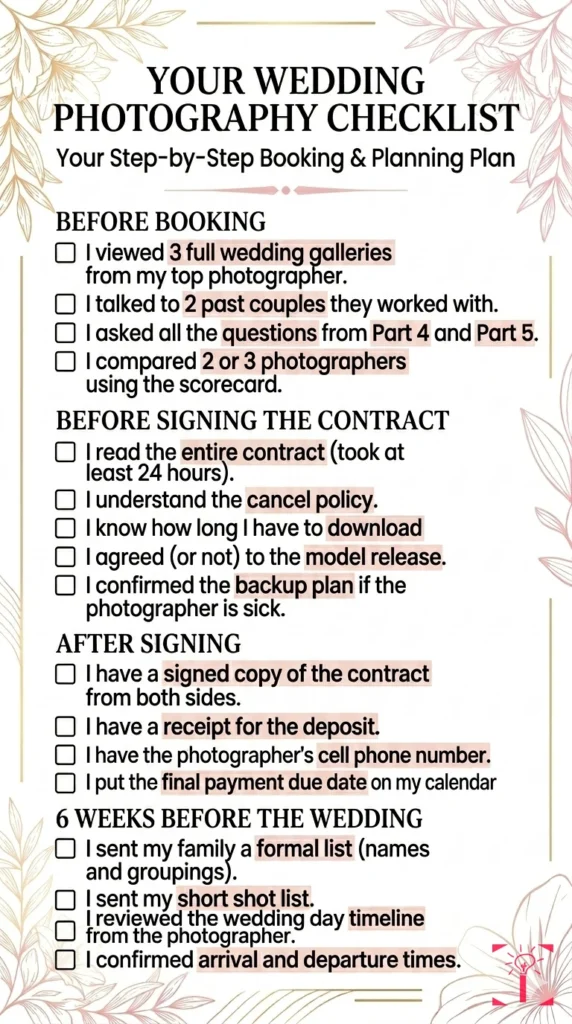
The Final Checklist (Print This!)
Use this checklist to make sure you haven’t missed anything.
You are done. Seriously. You’ve done the work. Yay! Give yourself a pat on the back, you deserve it.
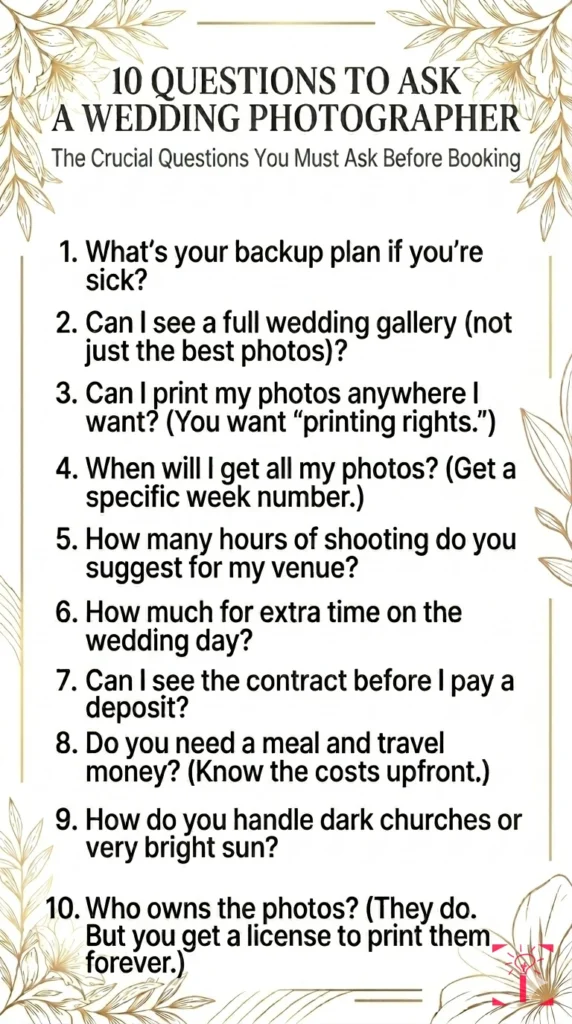
Quick Reference Card – 10 Easy Questions to Ask Before You Book
Save it on pinterest.
You’ve Got This
Booking a wedding photographer is not magic. It’s just a series of small, simple steps: decide what you want, ask the right questions, read the contract, and trust your gut.
Now you have everything you need. No confusion. No hidden surprises. Just great photos and a calm, happy wedding day.
Go book your photographer. And congratulations!
