How to Choose Your Wedding Venue
I’ll tell you something nobody says loudly enough when you get engaged. The venue isn’t just where your wedding happens. It is your wedding.
Everything else builds around it. The date, the guest list, the flowers, the photographer, the budget, the vibe, the feeling people carry home with them at the end of the night.
All of it flows directly from the room, the garden, the rooftop, or the barn you choose first. You get it right, and the rest of the planning process has this wonderful momentum to it, like dominoes falling exactly the way they should.
Get it wrong, and you’ll spend the next twelve months trying to make something work that was never quite right to begin with.
And yet, most couples spend more time researching their next laptop purchase than they do choosing their wedding venue. I say this with love because it’s completely understandable and also genuinely something we need to fix right now.
This guide covers everything. Where to start before you’ve even looked at a single venue, what to look for when you visit, the questions that separate good venues from great ones, how to compare your options without losing your mind, how to negotiate, what’s hiding in that contract, and what to do the moment you’ve signed.
By the end of this, you’ll walk into every venue tour knowing exactly what you’re looking for and exactly what you’re not. And maybe you might even become Miranda Priestly and boss everyone around!
Lock in your venue before you book a single other vendor. Your venue gives you your date. Your date gives you everything else. Photographers, florists, caterers, all the good ones book up fast, and more couples than you’d believe have lost their dream supplier simply because the venue came too late. Venue first. Everything else second. That’s the rule.
I. Before You Start Venue Hunting
Lock In Your Non-Negotiables First
Before you send a single inquiry email or walk through a single gate, sit down with your partner and agree on a handful of non-negotiable parameters. These are not vague preferences I’m talking about. They are boundaries that will immediately filter out venues that are wrong for you, saving you enormous time and emotional energy.
- Guest count. Your approximate headcount is the most important filter of all. Be honest, not aspirational. If your realistic guest list is 120 people, do not fall in love with a venue that holds 80. Equally, do not book a cavernous ballroom designed for 400 when you are hosting 90. Both situations are uncomfortable in different ways. Even a range, say, 100 to 150, gives you something concrete to work with. Get our FREE guest list planner if your guest list isn’t finalized yet.
- Budget. Venues typically consume 30 to 40 percent of a total wedding budget, and that figure often surprises couples who have not done the math in advance. Be honest with yourselves about this number before you fall in love with something out of reach. It will save you heartbreak later. Go through our wedding budgeting guide to decide your wedding budget.
- Season and preferred dates. Do you have a specific date in mind, or is your timeline flexible? Flexibility is a powerful tool. Venues are significantly cheaper on weekdays, in off-peak months, and outside of peak wedding season. If you are set on a Saturday in the high season, know that you are entering the most competitive and expensive territory. Just a heads up to plan accordingly.
- Indoor, outdoor, or a mix. This is partly about aesthetics and partly about practical risk management. Outdoor venues are beautiful but come with weather uncertainty. If you love the idea of an outdoor wedding, make sure you also love the venue’s backup plan for rain or extreme heat.
- Destination or hometown. A destination wedding adds logistical complexity for you and financial pressure for guests. It can be magical, but it requires much earlier planning (sometimes 18 months to 2 years in advance. A clear-eyed understanding of who on your guest list can realistically travel.
Types of Venues to Consider
Part of the joy of this stage is discovering how many different kinds of spaces can become a wedding venue. Sometimes I see a few venues that genuinely deserve a standing ovation to the couple who could see the vision behind the venue & make their dream come true. Here is a breakdown of the main categories:
- All-inclusive banquet halls and hotels. The most turnkey option. Catering, furniture, basic décor, and a coordinator often come bundled into the package. It’s convenient and predictable, but they can feel generic without deliberate personalisation. This one’s the one you need to work a lot with if you want to make a statement.
- Historic estates, heritage homes, and palaces. These venues bring architectural drama and a powerful sense of occasion. They are gorgeous, but sadly, they often come with strict rules about décor and approved vendors, so read the fine print carefully, I mean, very carefully.
- Outdoor venues (gardens, beaches, vineyards, farmhouses) are visually spectacular and creatively flexible, but they require more logistical planning. I am talking marquees, lighting rigs, generators, and portable restrooms. Weather contingency is a no-brainer. We don’t want to end up like Cam & Mitch on their wedding day!
- Destination resorts. For couples who want to combine the wedding with a holiday experience for guests. Resorts often have multiple event spaces, accommodation on-site, and experienced wedding planning teams.
- Intimate spaces (restaurants, rooftops, art galleries, private clubs) are perfect for smaller, more curated celebrations. These spaces offer character and originality, but check capacity carefully before getting attached.
- Religious venues. Many couples hold their ceremony at a place of worship and their reception elsewhere. If this is your plan, confirm early whether your reception venue can accommodate a gap between events.
How Many Venues to Shortlist
The ideal shortlist, I’d say, contains three to five venues. Fewer than three doesn’t give you a lot of perspective, and more than five becomes overwhelming and leaves you puzzled. Visit all of them before making any decisions. I am stressing on it, even if you fall deeply in love with the first one you see.
II. Visiting Venues: What to Look For In Person
No amount of photography, video walkthroughs, or Instagram browsing replaces a site visit. Venues are three-dimensional, sensory experiences. You need to feel the light in the main hall at the time of day your reception will take place.
You need to hear what the acoustics are like. You need to walk the path from the ceremony space to the reception area and understand whether that journey is beautiful or awkward.
Before you go. Let me pack your essentials kit for you: your camera or smartphone, a rough floor plan or capacity numbers from the venue’s website, your guest count, your prepared questions (I’ve added more details regarding this in the next section), and ideally, a trusted second opinion (a parent, a close friend, or your wedding planner).
First Impressions and Ambience
The moment you arrive, pay attention. Is the approach beautiful? Does the entrance create a sense of occasion? Is the signage clear and the reception desk welcoming?
First impressions matter enormously to you in this moment. But more importantly, they are what your guests will experience on the day. Walk in and ask yourself honestly,” Does this feel like the wedding I am imagining?”
Capacity and Flow
A venue may technically accommodate your guest count, but capacity and comfort are two different things. (trust me). Stand in the ceremony space and imagine your chairs arranged in rows. Walk into the cocktail area and picture guests circulating with drinks.
Look at the reception room and ask the coordinator to show you the proposed dinner layout, including the dance floor. Is there a logical, beautiful flow from arrival through to the end of the evening? Or do guests have to file through a service corridor to move from one space to another?
Lighting
Lighting makes or breaks your photographs and your guests’ experience more than almost any other single element. In the daytime, note where the natural light falls. In the evening, assess the existing artificial lighting.
Notice if it is warm or cold, flattering or harsh? Ask how much flexibility you have to supplement it with your own lighting supplier. And ask specifically about candles because some venues prohibit open flames entirely for insurance reasons, which rules out pillar candles and taper candles.
Acoustics
Clap your hands once in the main reception room and listen. Hard surfaces and high ceilings can create an echo that makes live music sound muddy and speeches difficult to follow.
Soft furnishings, draping, and carpet absorb sound. Ask whether there is an in-house PA system, whether they have hosted live bands before, and whether there are noise restrictions that would limit your music choices.
Restrooms, Parking, and Accessibility
These are the unsexy, practical details that directly affect guest experience. How many restrooms are there, and are they adequate for your headcount? Is parking easy and plentiful, or will guests be parking far away?
Is the venue genuinely accessible for elderly guests or those with mobility limitations, or are there unavoidable steps, narrow doorways, or uneven cobblestones? I know it’s a lot of not-so-interesting questions, but we must sort these out!
Proximity to Accommodation
Consider how easy it is for out-of-town guests to get from the venue to where they will be sleeping. Is there a hotel nearby? Does the venue have on-site rooms? Is there a reliable taxi or rideshare service in the area? The easier you make this for guests, the more they will be able to relax and enjoy themselves on the day.
III. Questions to Ask Your Wedding Venue
This is the most critical section of your venue research. Many couples arrive at a venue visit unprepared and leave dazzled by the décor but unclear on the details that will govern their entire experience. The questions below are organised by category. So you can work through them systematically, and do not leave without written answers to every point that matters to you.
A. Availability and Booking
- Is our preferred date available? If not, what is the nearest available date?
- Can you hold the date for us while we consider our options, and if so, for how long?
- How many events do you host on the same day? Are we the only wedding that day, or will other events be running simultaneously in different spaces?
- What does the booking process look like? Deposit amount, timeline, and steps to confirm?
- What is your cancellation policy, and under what circumstances is the deposit refundable?
B. Capacity and Layout
- What is the maximum seated capacity for a dinner reception, and the maximum standing capacity for a cocktail event?
- Can you host both the ceremony and the reception on-site, and if so, in which spaces?
- If we are holding the ceremony outdoors, what is the rain or extreme weather contingency plan?
- Are all the spaces we are considering ours exclusively for the duration of our booking, or could other events be happening nearby?
- Is there a dedicated bridal suite or getting-ready room available from the morning of the wedding?
- Can we see a floor plan of the reception space with our guest count laid out?
C. Cost and Packages
- What exactly does the venue hire fee include? Does it include furniture, linen, in-house lighting, and staff?
- Is catering in-house, or can we bring an external caterer? If in-house, what are the per-head costs and menu options?
- Is there a minimum food and beverage spend, and what happens if we do not meet it?
- What additional charges apply? Are there any service fees, taxes, gratuity, corkage, or overtime fees?
- What is the payment schedule, and when is the final balance due?
- Are there discounts available for off-peak dates, weekdays, or shorter event hours?
- What is included in your standard wedding package versus what costs extra?
D. Vendors and Restrictions
- Do you have a preferred or exclusive vendor list? If exclusive, can we use outside vendors at all?
- Can we bring our own alcohol, and if so, is there a corkage fee per bottle?
- What décor is permitted and what is restricted? What about open flames, confetti, flower petals, hanging installations, and smoke machines?
- Are there noise restrictions, a hard end time for music, or a decibel limit?
- Can we arrange a site visit with our florist, photographer, and other vendors in advance of the wedding day?
- Do you have a preferred DJ or band, or are we free to book our own entertainment?
E. Logistics and On-the-Day Support
- Will there be a dedicated wedding coordinator assigned to us on the day, and will it be the same person we have been working with in the lead-up?
- What are the venue’s set-up and tear-down windows? When can our vendors access the space, and when must everything be cleared?
- How many members of staff will be on-site during our event?
- Is there a generator or backup power supply in case of an outage?
- What are the parking arrangements for guests, and is valet parking available?
- Is the venue fully wheelchair accessible throughout all the spaces we will be using?
- Is there a secure area for gifts, and where do vendors load and unload equipment?
F. Accommodation and Guest Experience
- Does the venue have on-site accommodation, and if so, how many rooms are available? Is there a room block we can reserve for guests?
- Is there a honeymoon suite or special room for the couple on the night of the wedding?
- What transport options exist for guests travelling to and from the venue?
- Are there nearby hotels you would recommend for guests, and do you have a formal partnership with any of them?
- Is there a quiet or outdoor area for guests who need a break from the main event?
G. Contract and Contingencies
- What happens if the venue has to cancel our booking? What are we entitled to in terms of a refund or alternative arrangements?
- What is your force majeure policy? What qualifies, and what does it mean for our deposit?
- What liability insurance does the venue carry, and what insurance are we required to hold as the couple?
- Can the contract be amended if our guest count changes significantly after signing?
- Who is our primary point of contact, and what happens if that person leaves the venue before our wedding date?
Pro tip: Bring this list of questions printed out, with space to write answers. Do not rely on memory. The details blur together after two or three venue visits, and having notes to refer back to makes comparison far easier.
IV. Comparing Your Shortlisted Venues
Now, you’ve done your homework, or should I say groundwork? You have visited all your shortlisted venues and gathered answers to your questions; it is time for the most important task of this stage. Honest and Raw comparison. This is where emotion and logic need to work together. I know, I know you’re emotionally attached to one venue, but girl, let’s be real.
Create a Side-by-Side Comparison
Draw up a simple table. Be it on paper or in a spreadsheet with your shortlisted venues as columns and your key criteria as rows.
Make sure to include details like total estimated cost, included versus excluded items, capacity, available dates, vendor flexibility, location convenience, overall ambience, and any restrictions that concern you. Seeing everything laid out this way often makes the decision obvious.
Weight Your Factors
Not all criteria carry equal weight for every couple. If photography is paramount to you, lighting and backdrops matter more than a built-in dance floor.
If you have a large number of elderly guests, accessibility matters more than outdoor ceremony options. Before you compare, agree with your partner on your top three or four priorities, and let those guide the final decision.
Red Flags to Watch For
Pay close attention to the following warning signs during the process:
- Vague or evasive answers to direct questions about costs, restrictions, or inclusions. A good venue has nothing to hide.
- Pressure tactics like being told a date is “going fast” or that you need to decide within 24 hours. While popular venues do book up quickly, a reputable venue will give you reasonable time to make an informed decision.
- An unresponsive coordinator. If they take a week to reply to your emails before you have even signed, imagine what the lead-up to your wedding will feel like.
- Forced vendor packages with no flexibility. Being required to use only the venue’s approved vendors can significantly inflate your costs and limit your creative choices.
- Consistently poor reviews about day-of coordination, especially complaints about staff being unavailable, problems going unresolved, or couples feeling abandoned on their wedding day.
Ask for References
Any reputable venue should be able to provide references from couples who have celebrated there in the past twelve months. Take them up on it. A five-minute conversation with a past couple will tell you more about the reality of the venue experience than any amount of marketing material.
V. Negotiating With Your Venue
Once you have identified your preferred venue, do not simply accept the first quote. Negotiation is normal, expected, and often very productive. Here is how to approach it:
Know What Is Typically Negotiable
Venues are often more flexible than they initially appear in terms like the corkage fee, the hard end time for the event, restrictions on outside vendors, inclusions like a complimentary bridal suite or additional hours of access, and certain line items in the catering package. They are less flexible on their base venue hire fee, especially for peak dates.
Use Competing Offers Thoughtfully
If you have a genuine offer from a comparable venue at a lower price, it is entirely appropriate to mention this. You do not need to be aggressive or bluffing. A simple, polite statement like “We love this venue above the others we have seen, but the other space we are considering is offering X at a lower price. Is there anything you can do to meet us?” This is both honest and effective.
Consider Off-Peak Options
If you have flexibility in your dates, ask specifically about the pricing difference between a Saturday in peak season and a Friday or Sunday, or a date in the off-season. In many cases, the savings are substantial, sometimes 20 to 30 percent on the base venue fee, without any meaningful compromise on the experience.
Bundle to Add Value
Rather than simply asking for a discount, consider asking the venue to add value like a complimentary night in the honeymoon suite, an extended set-up window at no extra charge, or a waived corkage fee on wine. Venues often find it easier to give you something than to reduce their headline price.
Get Everything in Writing
Whatever is discussed verbally, confirm it in writing before you sign. If the coordinator tells you the music end time is negotiable, ask them to include that in the contract. Verbal assurances are not enforceable. Written addenda are.
VI. Reading and Signing the Contract
The contract is where the excitement of venue selection meets the reality of legal commitment. Many couples skim it, trusting that everything discussed was captured accurately. This is a mistake. Read every clause carefully, and if anything is unclear, ask for clarification before signing.
Key Clauses to Scrutinise
- The deposit and payment schedule. What percentage is required upfront, when is the balance due, and what triggers the release of each payment? Make sure these milestones align with your planning timeline.
- The cancellation policy. Under what circumstances do you forfeit your deposit? Is there a sliding scale for example, 50 percent back if you cancel more than 12 months in advance, nothing back if you cancel within 3 months? Understand exactly what your financial exposure is if circumstances change.
- The force majeure clause. This clause covers cancellations due to events outside both parties’ control, like natural disasters, government restrictions, and similar circumstances. After the events of recent years, this clause deserves very careful reading. Does it entitle you to a refund, a postponement credit, or nothing? Does it apply only to extreme events, or to a broad range of disruptions?
- Minimum spend requirements. If there is a minimum food and beverage spend, understand clearly what happens if you do not reach it. Some venues will simply charge you the difference regardless of what you consumed.
- Guest count adjustments. What flexibility exists if your confirmed headcount changes? Is there a deadline after which reductions are not accepted? Is there a per-head penalty for increasing numbers after a certain point?
What Must Be in the Contract
Ensure the contract explicitly states important deets such as the exact date and event hours, the specific spaces you are hiring, everything that is included in the price (furniture, linen, staff, AV equipment), all agreed exceptions to standard policy (such as permission to bring an outside caterer), the names of any specific staff members whose involvement has been promised, and all pricing including applicable taxes.
Wedding Insurance
This is the right moment to take out wedding insurance if you have not already. A comprehensive wedding insurance policy typically covers cancellation due to extreme weather, venue insolvency, supplier failure, and certain personal emergencies.
For a relatively modest annual premium, it gives you significant financial protection against the unexpected. Ask your venue what insurance they require you to hold, and then consider taking out a policy that goes beyond the minimum.
VII. After You Have Booked: What Comes Next
Signing the contract is not the end of your relationship with the venue. Just when you thought it was over, right? Surprise! It is the beginning of the working phase. How you manage this relationship in the months that follow will have a direct impact on how smoothly your wedding day runs. Check out our detailed how to plan your wedding guide.
Confirm Your Coordinator and Build the Relationship
As soon as you have signed, confirm in writing who your primary point of contact will be. If the venue assigns a dedicated wedding coordinator, introduce yourself properly, share your overall vision early, and establish a communication rhythm that works for both of you.
If the venue changes your coordinator at any point before the wedding, ask for a formal handover meeting so nothing falls through the gaps.
Create a Timeline of Check-Ins
Map out the key milestones between now and your wedding day that require venue input: the final guest count deadline, menu tasting date, floor plan confirmation, vendor access scheduling, final payment date, and the day-before walkthrough. Put all of these in your calendar with reminders, and do not wait for the venue to prompt you.
Share Venue Details With Vendors Early
As soon as you begin booking your other vendors, like photographer, florist, band, and lighting company, share the venue’s contact details, floor plans, and any relevant restrictions with them.
A photographer who has visited your venue before the wedding day will deliver significantly better results than one arriving for the first time. A florist who knows the ceiling height and lighting conditions will design arrangements that actually work in the space.
Schedule a Walkthrough Four to Six Weeks Before
Arrange a comprehensive walkthrough of the venue approximately four to six weeks before the wedding. Bring your wedding planner if you have one, and ideally your key vendors. Walk through the entire day in sequence, from the moment the first guests arrive to the end of the night.
Identify anything that needs to be resolved, like unclear logistics, missing equipment, or last-minute décor questions. All this while there is still time to address it calmly.
Confirm Day-Of Logistics in Writing
One week before the wedding, send the venue a written confirmation of the key day-of logistics: vendor arrival times, the running order of the day, final guest count, any special requirements, and the name of the person who will be your point of contact from the moment you arrive.
Ask them to confirm receipt and flag anything that needs to be adjusted. This one step prevents an enormous number of day-of surprises.
Your wedding venue is where one chapter ends, and the most beautiful one yet begins, and you deserve to walk into that space on your wedding day and feel it in your bones that it was exactly right. The kind that makes you stop mid-aisle, look around, and think “yes, this is it, this is us.”
Trust that feeling when it comes. You’ve done the research, asked the hard questions, and read every clause; now let yourself just be excited. The spreadsheets have done their job.
Here’s to the venue that sets the stage for the greatest night of your life and every beautiful memory that gets made there.
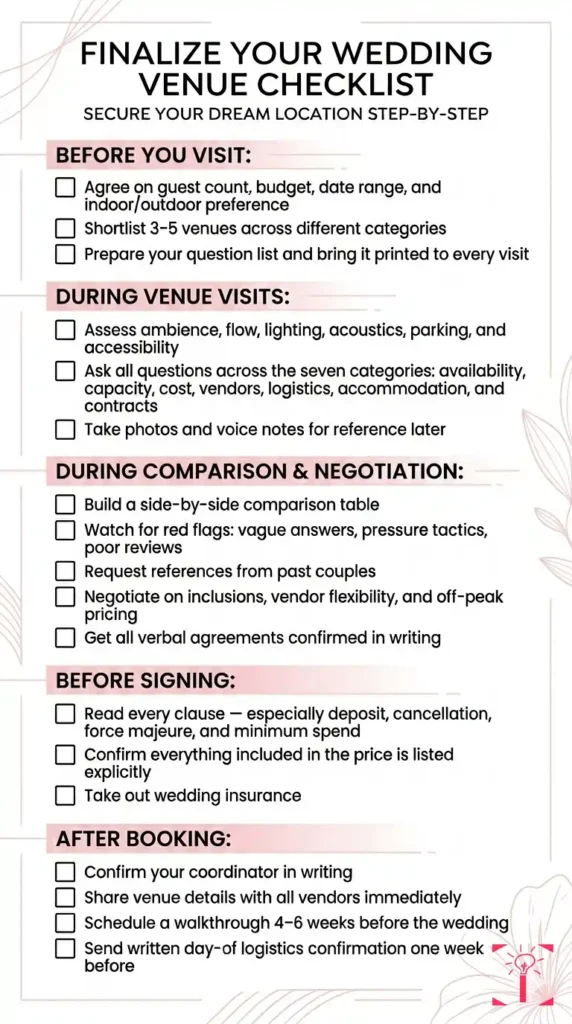
Quick Reference: Your Wedding Venue Checklist (Print this!)