
How to Choose Your Wedding Planner
So you just got engaged. The ring is on, the photos are posted, the congratulations are rolling in, and then, somewhere between the champagne and the chaos, someone leans over and says, “You should really get a wedding planner.”
And you think, do I, though? What do they even do? Is that not just for people with unlimited budgets and weddings that get featured in magazines?
My honest answer is that a good wedding planner is not a luxury. They’re the person standing between you and approximately four hundred decisions you didn’t know you’d have to make, vendor emails that multiply overnight, timelines that only make sense if you’ve done this before, and that specific 2 am panic where you can’t remember if you confirmed the florist or just dreamed that you did.
They are, in the most practical sense, the reason couples actually enjoy their own wedding instead of spending it putting out fires in a formal outfit.
I’ve made sure this guide walks you through all of it. What planners actually do, which type you actually need, how to find a good one, what to ask when you meet them, and what every line of that contract is really saying before you sign it.
By the end of this, hiring a wedding planner will feel less like a leap of faith and more like the easiest decision you’ve made since saying yes.

Part 1: First, Decide What Kind of Planner You Need
Not all wedding planners are the same. Some do everything. Some only show up at the end. You need to know which type fits your budget and your stress level.
Full‑Service Planner
- What they do: Everything. From the day you get engaged to the day you leave for your honeymoon. They help with budget, venue, vendors, design, timeline, and they are there on the wedding day.
- Best for: Couples with busy jobs, no time, or a big budget. Also great if you are planning a wedding from far away.
- Cost: Usually 10–15% of your total wedding budget. Or a flat fee of $5,000–$10,000+, depending on where you live.
Partial Planner
- What do they do? You do some of the early work (find the venue, pick a date), then they take over about 6 months before the wedding. They help with the remaining vendors, design, and logistics.
- Best for: Couples who want to be involved but need professional help to finish strong.
- Cost: Typically $3,000–$6,000, or a monthly retainer.
Month‑of Coordinator (also called Day‑of Coordinator)
- What they do: They take over 4–6 weeks before the wedding. They create the timeline, contact all your vendors, run the rehearsal, and manage every single thing on the wedding day. They do not help with finding vendors or designing before that.
- Best for: Couples who enjoy planning but don’t want to run the actual wedding day. This is the most popular choice.
- Cost: $1,000–$3,000 on average.
A la Carte / Hourly Consultant
- What they do: You pay for specific help, like reviewing a vendor contract, finding a caterer, or building a budget.
- Best for: Couples who only need a little guidance, not full planning.
- Cost: $100–$300 per hour.
Quick Quiz: Which One Is Right for You?
| Situation | Best Choice |
|---|---|
| I have no time and a good budget | Full-service planner |
| I can plan everything myself, but I don’t want to run the wedding day | Partial planner |
| I can plan everything myself, but don’t want to run the wedding day | Month-of coordinator |
| I just need help with one or two things | A la carte consultant |
Part 2: Know Your Budget for a Planner
Before you start calling anyone, decide how much you can spend on planning services. A common rule of thumb: 5–15% of your total wedding budget for full‑service planning. For a month of coordination, think $1,000–$3,000.
Be honest with yourself. If your whole wedding budget is $10,000, you probably cannot afford a $5,000 full‑service planner. That’s okay. A month‑of coordinator or a la carte help might be perfect.
Also, remember that a good planner can save you money by negotiating with vendors and preventing costly mistakes. So don’t just look at the price tag, look at the value.
Part 3: Where to Find Wedding Planners (And How to Spot Bad Ones)
Good Places to Look
- Wedding Wire and The Knot – They have reviews and real wedding photos.
- Instagram – Search “[your city] wedding planner” and look at their tagged photos (not just their own feed).
- Your venue’s preferred vendor list – Venues often work with planners they trust.
- Local Facebook wedding groups – Ask for recommendations from real couples.
- Friends and family – If someone you trust had a great planner, start there.
Red Flags to Watch For
- No contract or a very vague one (one page with almost no details).
- Can’t give you recent client references (or gives you only one name from five years ago).
- Seems confused about your venue or local vendors. If they don’t know the area, they can’t help as much.
- Doesn’t ask YOU any questions. A good planner is curious about your vision. If they only talk about themselves, walk away.
- Bad reviews about communication, like “Never replied to emails” or “Changed plans without telling us,” are huge red flags.
Part 4: Before You Reach Out – Get Your Own Basics Ready
You don’t need a full wedding plan yet. But you should have these five things written down before you contact any planner:
- Your wedding date or target month (e.g., “June 2027” or “sometime in the fall”).
- Approximate guest count (50? 150? 300? A close guess is fine).
- Rough total budget for the whole wedding (e.g., “around $25,000”).
- What do you need help with most? “I have no idea how to find a caterer,” or “I just need someone to run the rehearsal.”
- Your vision in a few words is a must. “Rustic barn wedding,” “Modern city hall,” “Small beach ceremony.”
Message Template to Send Planners
You can copy and paste this, then fill in your details:
“Hi [planner name],
I saw your work on [Instagram / Wedding Wire / a friend’s wedding]. We are getting married [month/year] with about [100] guests. Our total wedding budget is around [$20,000]. We think we need [full‑service / month‑of] planning. Are you available? Could we hop on a quick 15‑minute call this week? Thank you!”
Send this to 3–5 planners you liked. See who replies quickly and kindly.
Part 5: The First Call or Meeting – What to Expect
Most planners offer a free 15–30 minute call (phone or Zoom). Some will meet for coffee. Here’s what usually happens:
- They will ask about your wedding, your style, your budget, and your biggest worries.
- They will explain what they do and how they work.
- You will ask them questions (see the next section for a huge list).
- At the end, they may send you a proposal with pricing and a sample contract.
Take notes during the call. Or ask if you can record it (most will say yes). You will not remember everything.
Part 6: The Big List of Questions to Ask (Organized by Category)
Use these questions during your call. Don’t be shy. A good planner expects them.
Category A: Experience & Logistics (The Basics)
- How many weddings have you planned (or coordinated) from start to finish?
(Look for at least 20–30 if they are full‑service. For the month-of, 10+ is fine.) - How many weddings do you take on per month or per year?
If they do 10 weddings in one month, you will not get much attention. 2–4 per month is typical for a solo planner. - Have you worked at my venue before?
If no, “How do you learn a new venue?” (A good answer would be “I visit ahead of time or call the venue manager.”) - Do you have a list of preferred vendors (photographers, caterers, DJs)? Can I see it?
A good planner has trusted vendors. But be careful because some get kickbacks. Ask about that (see secret questions later). - Will YOU be the one at my wedding, or will you send an assistant or team member?
Make sure you know who is actually showing up. If they send an assistant you have never met, that’s a problem. - What is your backup plan if you are sick on my wedding day?
They should have another professional planner on call. “I would never be sick” is not a real answer. - Do you have liability insurance? (Many venues require it. Ask to see a certificate.)
Category B: Services & Responsibilities (What Exactly Do You Do?)
- Can you send me a detailed list of everything you handle vs. what I handle?
This is very important. Some planners do not set up decorations. Some do not handle cleanup. Get it in writing. - Do you help with budget planning and tracking?
(Yes for full‑service. Sometimes no for month‑of.) - Do you negotiate with vendors on my behalf?
A good planner will save you money by negotiating. Ask for examples. - Will you review vendor contracts before I sign them?
(Yes, this alone can save you from bad deals.) - Do you attend vendor meetings with me (or on my behalf)?
(Full‑service planners often attend or even go alone.) - Do you help with wedding design (colors, flowers, rentals) or just logistics?
(Know what you are paying for.) - Do you create the full wedding day timeline? How far in advance?
(Usually 4–6 weeks before the wedding.) - Do you handle setup and cleanup of decorations?
(Some planners do not touch decorations. If that matters to you, ask.) - Do you manage the rehearsal? How long?
(Usually 1 hour, including a walk‑through.)
Category C: Communication & Availability
- How quickly do you usually reply to emails or texts?
(Same day or within 24 hours is good. “Within a week” is too slow.) - How many in‑person or video meetings are included?
(Unlimited is nice, but 1–2 per month is typical.) - Do you have a portal or app where we can share files, budgets, and checklists?
(Many planners use tools like Aisle Planner, HoneyBook, or Google Drive.) - Will you give us homework or deadlines between meetings?
(Yes & this keeps you on track.)
Category D: Pricing & Payment
- What is your fee structure? (Flat fee? Percentage of wedding budget? Hourly?)
- Flat fee is easiest to understand.
- A percentage can be risky if your budget grows.
- Hourly is rare for full planning.
- What exactly is included in that price? (Ask for a written list.)
- Are there any extra fees I should know about? (Travel, parking, overtime, assistant fees, phone calls after hours.)
- How much is the deposit to book? (Typically 25–50%.)
- When are the remaining payments due? (Monthly? One lump sum before the wedding?)
- What is your cancellation policy? (If you cancel, do you get any money back? If they cancel, do you get a full refund?)
- Do you offer payment plans? (Many do.)
Category E: The Wedding Day Itself
- How many hours of on‑site coverage are included on the wedding day?
(Month‑of coordinators often work 8–10 hours. Full‑service may be from setup to cleanup.) - Do you stay until the end of the reception?
(Some leave after cake cutting. Ask.) - Do you handle emergencies (e.g., a vendor doesn’t show up, a guest gets sick)?
(Yes, a good planner is a problem‑solver.) - Do you have an emergency kit (safety pins, stain remover, Band-Aids)?
(Small thing, but very helpful.) - Do you manage the vendor arrival and setup schedule?
(Yes, they should be the point of contact for all vendors on the day.) - Will you hold the rehearsal and the wedding day timeline meetings?
(Yes, these are standard.)
Part 7: The “Secret” Questions That Reveal Problems
These questions are not rude. They show you did your homework & you know your way around. A great planner will answer happily. A bad planner will get nervous.
Question 1: “Can I talk to two or three couples you worked with in the last year?”
- Good answer: “Absolutely, here are their emails and phone numbers.”
- Red flag: “I don’t give out client info” or “Let me check if they are okay with that.” (They should have already asked past clients for permission.)
Question 2: “Tell me about a wedding that went wrong. What happened and how did you fix it?”
- Good answer: Honest story with a solution (e.g., “The florist was two hours late, so I ran to a grocery store and bought backup flowers while the bride got ready.”)
- Red flag: “Nothing ever goes wrong at my weddings.” (That’s a lie.)
Question 3: “What is something couples often forget to ask you about?”
- Good answer: “Parking fees for vendors,” or “That I don’t do setup of personal decorations.”
- Red flag: “I can’t think of anything.” (Then they surprise you later with extra costs.)
Question 4: “Do you receive any commissions or kickbacks from vendors you recommend?”
- Good answer: “Yes, sometimes, but I always tell you, and I only recommend vendors I truly trust. You can use anyone you want.”
- Acceptable: “No, I never accept kickbacks.”
- Red flag: “That’s none of your business” or “Why would you ask that?” (Walk away.)
Question 5: “Have you ever fired a client? Why?”
- This reveals their boundaries. A good answer might be: “Once, because the client lied about their budget and expected me to work for free.” That’s fair. A bad answer is ranting about a past client.
Part 8: Check References – What to Ask Past Couples
After your call, the planner should give you 2–3 references. Call them. Do not skip this step. Here is what to ask:
- Did the planner listen to your vision, or did they push their own ideas?
- Were they easy to reach when you had questions? (How fast did they reply?)
- Did they stay within your budget? (Did they help you save money?)
- Did anything go wrong on the wedding day? How did the planner handle it?
- Would you hire them again? (If they hesitate, that’s your answer.)
You can even ask, “What is one thing you wish they had done differently?” That often gets the most honest answer.
Part 9: The Contract – What to Read Before Signing
You have picked your favorite planner. Now they send a contract. Do not sign it in 5 minutes. Take at least 24 hours. Read every line and run it by your trusty friend.
8 Things to Look For in Every Planner Contract
- Scope of work – A clear, detailed list of what they will do and what they will NOT do. If it says “coordination services” but doesn’t mention setup or cleanup, assume they don’t do those.
- Payment schedule – Deposit amount, due dates for remaining payments, and late fees. Make sure you can afford the schedule.
- Cancellation policy – How much do you lose if you cancel? (30–50% of the total fee is common.) What happens if they cancel? (You should get a full refund plus help finding a replacement.)
- Substitution clause – Can they send a different planner without asking you? Look for wording like “may substitute with another associate.” You want the right to approve any replacement.
- Overtime fees – Hourly rate if the wedding runs long. Typically around $100–$200 per hour. Know this number.
- Travel & parking – Who pays? Is there a cap? Example: “Client pays actual parking fees, not to exceed $50.” If it’s open‑ended, you could get a surprise bill.
- Liability – The contract should say they have insurance. It should also say they are not responsible for vendor failures (e.g., the caterer doesn’t show), but they will help fix the problem. That’s normal.
- Termination for cause – Can you fire them if they do a bad job? Do you get any money back? Look for a clause that says if they breach the contract (don’t do their job), you get a refund of unused fees.
Don’t Be Afraid to Ask for Changes
You can say: “Could we add a line that says you will give me 7 days’ notice before substituting another planner?” Many will say yes. If they refuse to change anything, think twice.
Part 10: The Final Steps to Book Your Planner
Once you are happy with the contract, follow these steps:
- Compare 2–3 planners using a simple scorecard (see below).
- Ask for the final contract and proposal in writing.
- Take 24–48 hours to read the contract. I repeat, do not rush.
- Call one reference from each finalist.
- Trust your gut. Who made you feel calm, understood, and confident?
- Sign the contract (both of you, electronically or on paper).
- Pay the deposit using a credit card if possible (credit cards give you dispute rights if things go very wrong).
- Get a signed copy back from the planner. Save it on your computer AND in the cloud (Google Drive, Dropbox).
- Schedule your first official planning meeting. Usually, within a week of booking.
Simple Scorecard to Compare Planners
| Area | Weight (1–5) | Planner A | Planner B |
|---|---|---|---|
| Experience (weddings done, venue knowledge) | |||
| Services offered (matches what you need) | |||
| Personality (did you feel comfortable?) | |||
| Price (fits your budget) | |||
| Communication (fast replies, clear answers) |
Add up the scores. If it’s close, pick the one who answered your questions most honestly and made you feel safe.
Part 11: After Booking – What Happens Next (The First 30 Days)
You did it! You have a planner. Here is what usually happens in the first month:
- Welcome packet – They will send you a guide, a timeline, and a list of what you need to do first.
- Budget tracking – They may share a spreadsheet or app to track every expense.
- Shared folder – Google Drive or Dropbox where you put contracts, inspiration photos, and guest lists.
- Vision board – They will ask for your Pinterest board or a few photos of weddings you love.
- Regular meetings – Usually every 2–4 weeks, depending on how close the wedding is.
Your job now is to show up to meetings on time, answer their questions, and do the homework they give you. The more you cooperate, the better your wedding will be.
Part 12: Red Flags After Booking (When to Fire Your Planner)
Hopefully, you never need this section. But if you see any of these signs after you’ve booked, it’s time to review your contract and consider firing them.
- They stop replying to emails for more than a week with no notice (e.g., “I’m on vacation”).
- They forget what you discussed in previous meetings (e.g., you already told them your colors twice).
- They show up late to vendor meetings or calls.
- They pressure you to use expensive vendors and get angry when you say no.
- They make mistakes that cost you time or money (e.g., booking the wrong date with a vendor).
If you see these, first talk to them directly. Say, “I’m worried about X. Can we fix this?” If they don’t change, look at your contract’s termination clause. You may be able to fire them and get a partial refund.
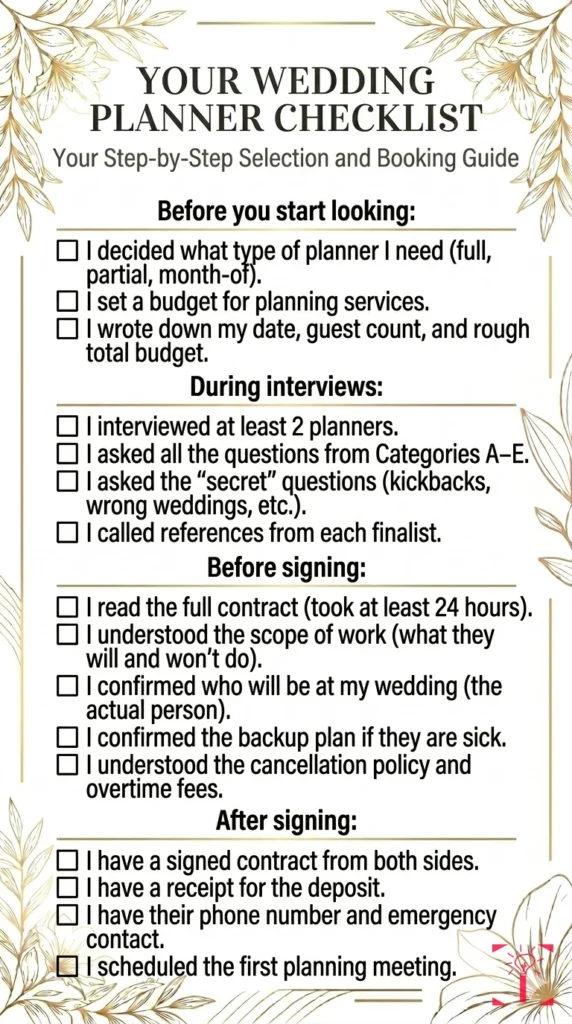
Final Checklist (Print This!)
Use this checklist to make sure you haven’t missed anything.
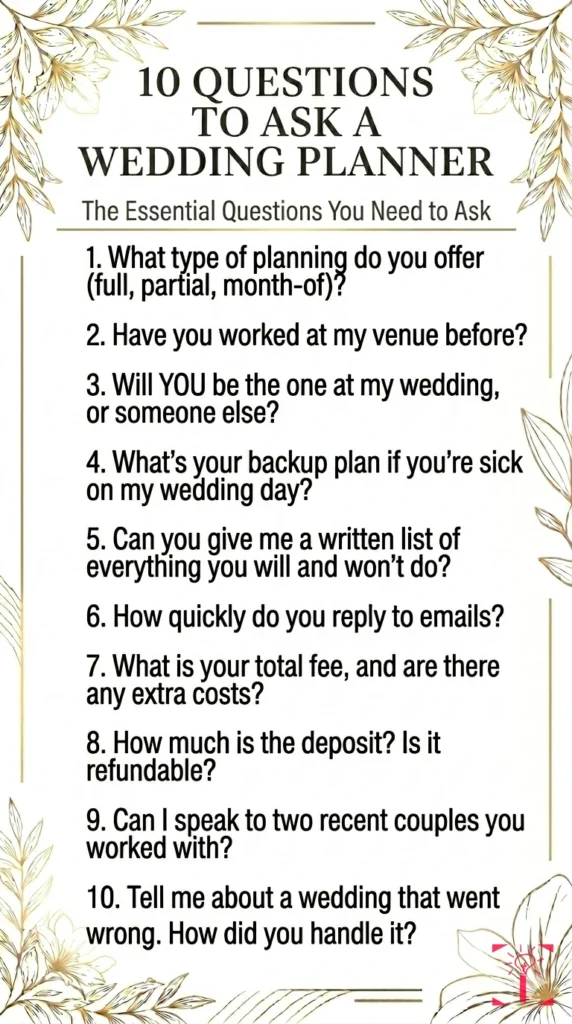
Quick Reference Card – 10 Easy Questions to Ask Any Wedding Planner
Save it on pinterest.
Planning a wedding is one of the most exciting things you’ll ever do, and the right planner makes sure it actually feels that way, from the first vendor call all the way to the last song of the night.
You came into this not knowing what a wedding planner even does, and now you know exactly what to look for, what to ask, and what to never sign without reading twice.
The only thing left to do is find your person. The one who gets your vision, respects your budget, and makes you feel like everything is completely under control, even when it isn’t. That person exists, and you’re ready to find them.
Congratulations and happy trails!