
How to Choose Your Wedding Florist
You wanted flowers. Simple, beautiful wedding flowers.
And then you opened your laptop and fell headfirst into a world where bouquets have seventeen different names, every arrangement comes with a Latin plant species you’ve never heard of, and somehow a table centerpiece costs more than your first car payment.
Welcome to wedding floristry. It’s stunning in here. It’s also a little unhinged. When I say “little,” yeah, you get me, right?
Here’s the thing nobody tells you (but I will): Flowers are one of the most emotionally loaded parts of wedding planning because they’re everywhere. Your bouquet, the ceremony arch, the reception tables, the flower girl basket, and the boutonniere that the groom’s dad will immediately take off and put in his pocket.
Every single moment of your wedding day has a floral moment attached to it, which means the florist conversation matters a lot more than couples expect going in.
And the pricing? It can feel completely random until someone explains how it actually works, which is exactly why I am here. Flowers should be the fun part. Let’s make sure they are.
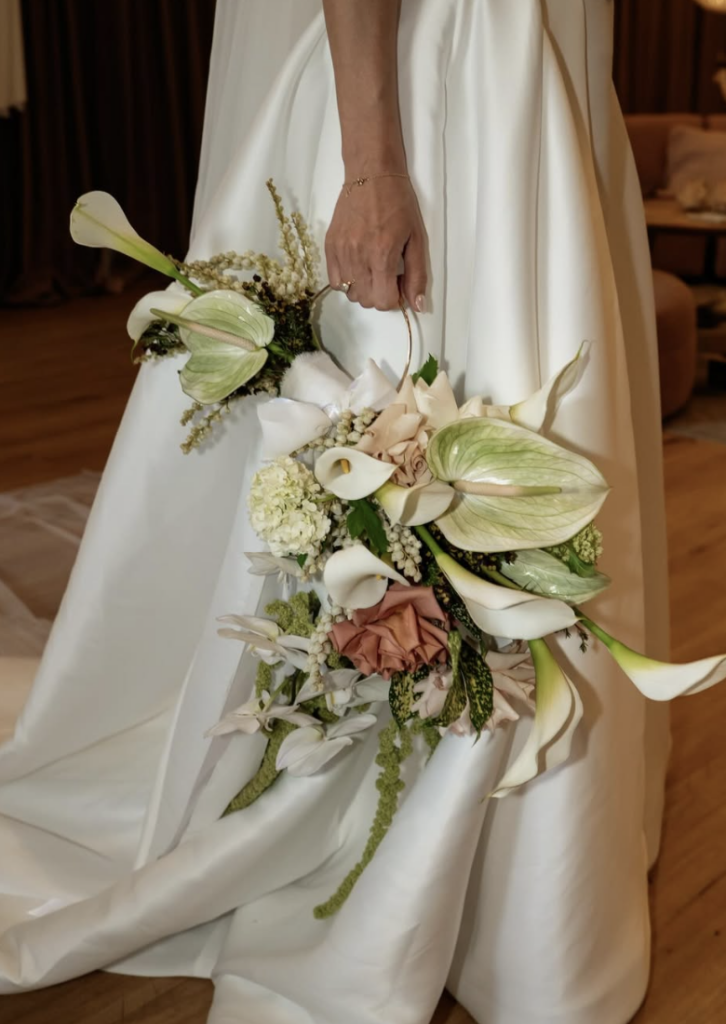
Part 1: First, Understand What a Wedding Florist Does (And Doesn’t Do)
What a Florist Does
- Designs and arranges fresh flowers for your wedding.
- Makes bouquets for the bride, bridesmaids, and sometimes flower girls.
- Creates boutonnieres (small flower pins) for the groom, groomsmen, fathers, and grandfathers.
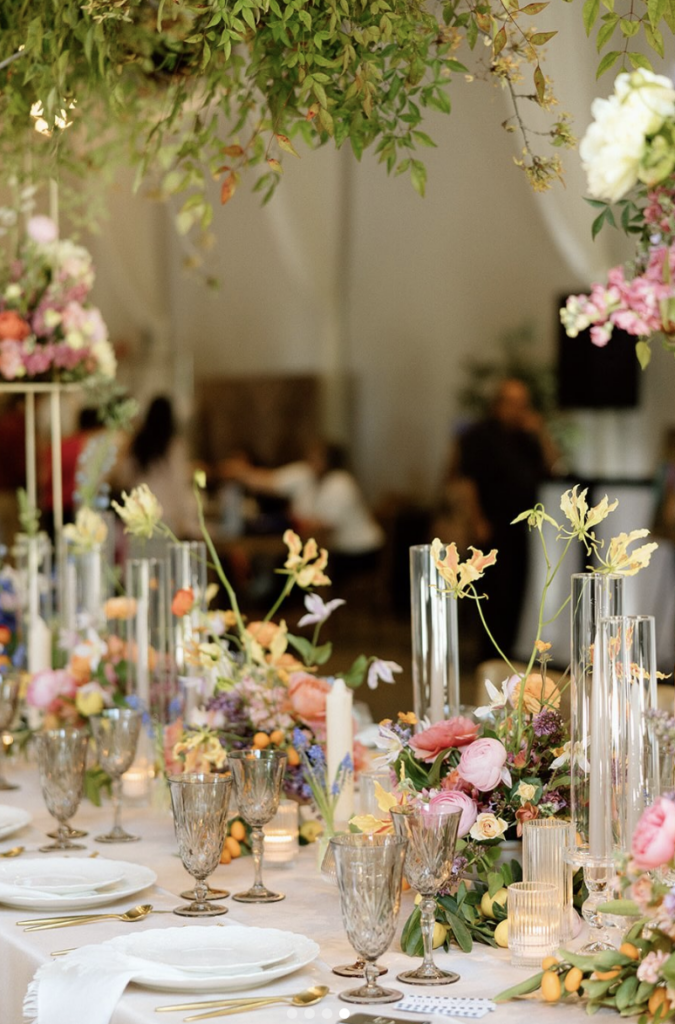
- Makes centerpieces for guest tables, the sweetheart table, the cake table, and the bar.
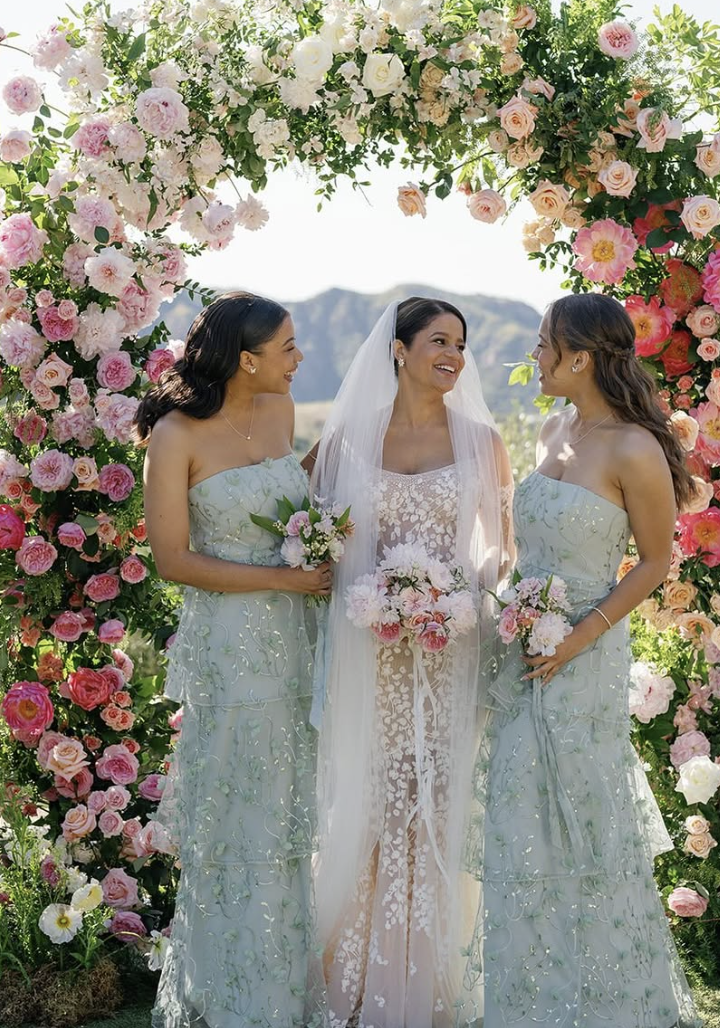
- Decorates the ceremony space (arch, aisle markers, pew ends, altar flowers).
- Delivers everything to your venue on the wedding day.
- Sets up the flowers exactly where you want them.
- Comes back after the reception to clean up and remove the flowers (if you pay for pickup).
What a Florist Usually Doesn’t Do
- Provide non‑floral decor (candles, signs, fabric, fairy lights, vases, unless you rent them from the florist).
- Set up items they didn’t provide (e.g., your DIY signs or family photos).
- Stay for the whole wedding (they deliver, set up, and leave; some come back for pickup later).
- Serve as a wedding planner or coordinate other vendors.
Types of Florists (So You Know What You’re Paying For)
| Type | What They Do | Best For | Typical Price Range |
|---|---|---|---|
| High‑end / full‑service florist | Everything, including large installations (flower walls, hanging chandeliers). Very artistic. | Big budgets, elaborate weddings | $5,000 – $20,000+ |
| Mid‑range / studio florist | A la carte/bulk flower supplier | Most weddings | $1,500 – $4,000 |
| Grocery store or DIY‑friendly florist | Basic arrangements, often at lower prices. Less design help. You may need to pick up and set up yourself. | Tight budgets, simple flowers | $300 – $1,200 |
| A la carte / bulk flower supplier | Sells you buckets of loose flowers. You arrange everything yourself. | Very crafty couples, very low budgets | $200 – $600 (plus your time) |
Most couples choose a mid‑range studio florist. I wanted this guide to focus on that.
Part 2: Know Your Flower Budget Before You Call Anyone
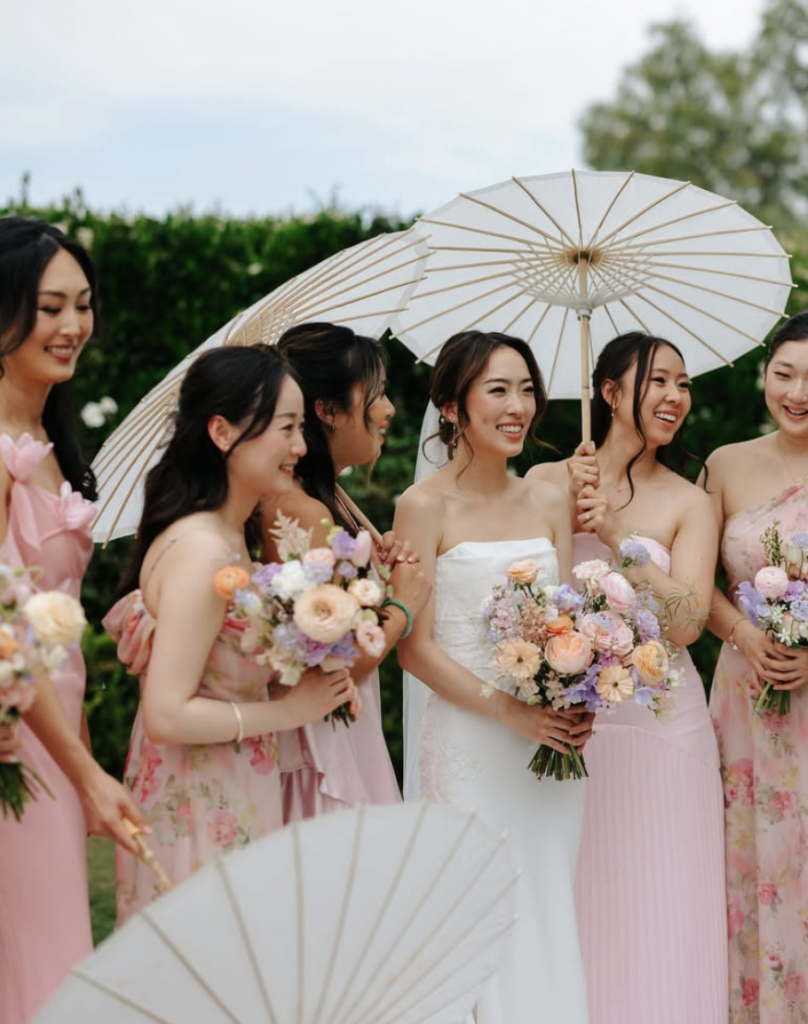
Flowers can cost more than you expect. A good rule of thumb: 8–15% of your total wedding budget goes to flowers.
For a $20,000 wedding, that’s $1,600–$3,000.
What Affects the Cost
Here is a heads-up you didn’t know you needed.
- Season: Out‑of‑season flowers (like peonies in winter) are shipped from far away and cost much more.
- Number of arrangements: More tables, more bouquets = more money.
- Size and complexity: A simple mason jar with a few roses is cheap. A tall, lush centerpiece with 20 stems is expensive.
- Labor: Intricate designs (cascading bouquets, hanging installations) take hours to make.
Realistic Prices (So You Don’t Get Shocked)
| Item | Typical Price Range |
|---|---|
| Bridal bouquet | $150 – $350 |
| Bridesmaid bouquet | $60 – $120 each |
| Boutonniere | $15 – $25 each |
| Corsage (for mothers/grandmothers) | $20 – $35 each |
| Centerpiece (low, simple) | $50 – $100 each |
| Centerpiece (tall or lush) | $150 – $300 each |
| Ceremony arch (flowers only) | $500 – $2,000+ |
| Aisle markers (4–6 small arrangements) | $100 – $300 |
| Flower petals (for tossing or aisle) | $50 – $150 |
These are averages. Your city and the florist’s experience will ofcourse change the numbers.
Part 3: Where to Find Wedding Florists (And How to Spot Bad Ones)
Good Places to Look
- Instagram – Search “[your city] wedding florist” and look at their tagged photos (not just their own feed).
- Wedding Wire and The Knot – They have reviews and real wedding galleries.
- Your venue’s preferred vendor list – Venues know which florists are reliable.
- Your wedding planner’s recommendations – Planners work with florists all the time.
- Local Facebook wedding groups – Ask for real couple experiences.
Red Flags to Watch For
- No portfolio or only a few blurry photos.
- Won’t give you a written proposal (only verbal quotes).
- Can’t tell you what flowers are in season on your date (they should know).
- Bad reviews about wilting flowers, late delivery, or wrong colors.
- Requires full payment upfront with no contract.
- Has a very high minimum order (e.g., $3,000) that you didn’t expect.
Part 4: Before You Reach Out – Get Your Own Flower Ideas Ready
You don’t need to know flower names. But you should have a few things prepared so the florist can give you an accurate quote.
Create a Simple Inspiration Folder
There are so many cute flowers inspo out there that it might be overwhelming for you. You have your Spring wedding flowers, fall wedding bouquets, and even fall wedding flowers. I suggest it’s better you visualise your preferences and create a simple inspo folder with the ones that resonate the most with you!
Use Pinterest or save Instagram photos. Make sure to include:
- Bouquet styles (round, cascading, loose, wild).
- Color palette (e.g., blush, white, soft blue, eucalyptus green).
- Centerpiece styles (tall, short, mixed greenery, single stem in a bud vase).
- Ceremony flowers (arch, aisle markers, flower petals).
Know Your Answers to These Questions
- How many bridesmaids? (Count each person getting a bouquet.)
- How many groomsmen? (Count each boutonniere.)
- How many parents/grandparents? (Boutonnieres and corsages.)
- How many guest tables? (Don’t forget the sweetheart table, cake table, gift table, and oh yes, the bar.)
- Do you want flowers for the ceremony arch, aisle, or pews?
- Do you need delivery and setup? (Almost always yes.)
- Do you need pickup and cleanup after the reception? (Some couples skip this and let guests take flowers home.)
Set a Rough Budget Total
Be honest with yourself and the florist. Example: “I want to spend around $1,500 total, including delivery.”
Message Template to Send Florists
You can copy and paste this, then fill in your details:
“Hi [florist name], I love your work! My wedding is [date] at [venue]. I have about [100] guests, [6] bridesmaids, [8] groomsmen, and [15] tables. My flower budget is around [$1,500]. Are you available? Could we set up a quick call or in‑person chat?”
Send this to 3–5 florists. See who replies warmly and quickly.
Part 5: The First Call or Meeting – What to Expect
Most florists offer a free 15–30 minute consultation. It can be over the phone, Zoom, or in person (often at their studio).
What They Will Ask You
- Your wedding date and venue.
- Your color palette and style (show them your inspiration folder).
- Your favorite flowers (if any).
- Your budget (be honest because it saves everyone time).
What You Will Do
- Ask them questions (see the big list in Part 7).
- Look at their portfolio (ask to see weddings similar to your budget and style).
After the Meeting
The florist will send you a written proposal. It is usually a detailed list of each flower item, quantity, and price. This is not a contract yet. It’s an estimate.
Part 6: The Big List of Questions to Ask (Organized by Category)
Use these questions during your call or meeting. A good florist expects them and will answer happily.
Category A: Experience & Logistics
- How many weddings have you done?
(At least 20–30 is good for a professional.) - Have you worked at my venue before?
If no, ask “Will you visit it beforehand or talk to the venue coordinator?” (They should.) - How many weddings do you take on per weekend?
Too many (like 8–10) means rushed work and possible late deliveries. - Do you deliver and set up the flowers on the wedding day? Is that included in the price?
(Yes for most florists, but do confirm.) - Do you do pickup and cleanup after the reception?
(Some charge extra. Some don’t offer it at all. Know before you book.) - What time will you deliver on the wedding day?
(Should be early, at least 2 hours before guests arrive, often before the photographer starts taking getting‑ready photos.) - What is your backup plan if flowers arrive damaged or late?
(Good answer: “I have extra blooms and a backup driver.”)
Category B: Flowers & Design (The Important Stuff)
- What flowers are in season on my wedding date?
In‑season flowers are cheaper and fresher. Ask for a list. - Can you show me photos of weddings you’ve done with a similar budget and style to mine?
(Not just the expensive, huge weddings.) - Do you create a mock‑up or sample bouquet before the wedding?
(Some do for an extra fee. Others work from photos.) - Can I substitute flowers to save money?
Example: swap expensive peonies for garden roses or carnations. A good florist will help. - Do you have a minimum order amount?
Many florists have a minimum of $1,000–$2,500. If yours is lower, ask if they will still work with you. - Will you reuse the ceremony flowers at the reception?
This is a great money‑saver. Example: the arch flowers can become the sweetheart table centerpiece. - Do you provide vases, holders, and other supplies? Is there a rental fee or deposit?
Some include basic vases. Others charge a rental fee (you return them after the wedding). - What happens to the flowers after the wedding?
Do you take them? Does the florist pick them up? Can guests take them? Know the plan.
Category C: Pricing & Proposal (Get It in Writing)
- Can you give me a detailed, written proposal before I book?
(Yes. Never accept a verbal quote.) - Does your proposal include delivery, setup, and pickup fees?
Ask to see line items. Some florists hide fees. - Are there extra fees for holidays, early morning (before 8 AM), or complex installations?
(Good to know upfront.) - What is your deposit to book the date?
(Usually 30–50% of the total.) - When is the final payment due?
(Often 1–2 weeks before the wedding.) - What is your cancellation policy?
If you cancel, do you get any money back? If they cancel, do you get a full refund? - What if I add or remove flowers later?
Is there a deadline for changes? (Usually 2–4 weeks before the wedding.)
Category D: The Wedding Day & Emergencies
- Who will be delivering and setting up?
The florist personally, or an assistant? (Both are fine, just know, it’s always better.) - Do you have a backup vehicle or cooler in case of a breakdown?
(A professional florist does.) - How do you keep flowers fresh during a summer wedding?
(Coolers, shade, water tubes, misting. Ask for details.) - What happens if a bouquet breaks or flowers wilt during the day?
Do you have extra blooms or a small emergency kit? - Do you provide pins, tape, or extra supplies for the bridal party?
(Very helpful for fixing boutonnieres or loose stems.)
Part 7: The “Secret” Questions That Reveal Problems
These questions are not rude. They show you are a smart & well-prepped client. A great florist will answer honestly.
Question 1: “Can I speak to two recent wedding clients of yours?”
- Good answer: “Absolutely, here are their email addresses.”
- Red flag: “I don’t give out client info” or “Let me check.” (They should have permission already.)
Question 2: “Tell me about a time flowers arrived late or damaged. What did you do?”
- Good answer: An honest story with a solution (e.g., “I ran back to the shop and remade the bouquet in 20 minutes.”)
- Red flag: “That never happens to me.” (That’s not true.)
Question 3: “What is something couples often forget to ask you about?”
- Good answer: “Delivery windows,” “That we don’t do cleanup unless you pay extra,” or “That vases need to be returned.”
- Red flag: “I can’t think of anything.” (Then they surprise you later.)
Question 4: “Do you offer any discounts for using only in‑season flowers?”
- Good answer: “Yes, I can help you choose beautiful in‑season blooms to save money.”
- Red flag: “No, my prices are the same no matter what.” (That’s unusual.)
Part 8: Check References – What to Ask Past Couples
After your call, the florist should give you 2–3 references. Call them. Do not skip this step. Here’s what you can ask:
- Did the flowers look like the inspiration photos? (Were the colors and style correct?)
- Were the flowers delivered on time and fresh? (Any wilting or browning?)
- Was the florist easy to communicate with? (Did they reply to emails and calls?)
- Did any flowers wilt or die before the reception? How was it handled?
- Would you hire them again? (If they hesitate, that’s your answer.)
Also ask, “What is one thing you wish they had done differently?” That often gets the most honest answer.
Part 9: The Proposal & Contract – What to Read Before Signing
You have picked your favorite florist. Now they send a proposal and a contract. Do not sign in 5 minutes. Take at least 24 hours.
What a Good Proposal Includes
- List of every item (e.g., “1 bridal bouquet cascading, blush peonies and roses”).
- Quantity of each item (e.g., “6 bridesmaid bouquets”).
- Flower types and colors (or “designer’s choice in blush/white palette” if you’re flexible).
- Delivery, setup, and pickup times.
- Total price with tax and fees broken down.
What the Contract Must Have
| Clause | Why It Matters |
|---|---|
| Scope of work | A clear list of what they deliver, set up, and clean up. No surprises. |
| Payment schedule | How much do you lose if you cancel? What happens if they cancel (full refund + help finding a replacement). |
| Cancellation policy | How much do you lose if you cancel? What happens if they cancel (full refund + help finding a replacement)? |
| Substitution clause | Example: “Delivery by 10:00 AM on the wedding day.” Not “morning of.” |
| Delivery window | Cleanup/pickup details |
| Who removes flowers after the reception? By what time? | Who is responsible if the flowers are damaged after delivery? (Usually, the venue or couple, after the florist leaves, read this carefully.) |
| Liability | Who is responsible if the flowers are damaged after delivery? (Usually, the venue or couple, after the florist leaves, read this carefully again.) |
Don’t Be Afraid to Ask for Changes
You can say: “Could we add a line that says you will send a photo of the bouquet before delivery?” Many florists will say yes. If they refuse to put anything in writing, think twice.
Part 10: How to Save Money on Wedding Flowers (Without Looking Cheap)
You don’t have to spend a fortune to have beautiful flowers. You can try these trusted tips:
- Use in‑season flowers only. Ask your florist for a list of what’s blooming on your date.
- Choose hardy blooms. Roses, carnations, mums, and alstroemeria last all day. Peonies and gardenias are delicate and expensive.
- Repurpose ceremony flowers at the reception. Move arch flowers to the sweetheart table. Use aisle markers as centerpieces.
- Use more greenery, fewer blooms. Eucalyptus, ferns, olive branches, because greenery is cheap and looks lush.
- Skip flowers for the groomsmen. Give them a simple greenery sprig or a single rose. No one will notice.
- Do your own bud vases. Buy a few bunches of grocery store flowers and put one or two stems in small vases. Very cheap and charming.
- Ask for “designer’s choice.” Tell the florist your colors and let them pick the flowers based on what’s fresh and in season. This saves labor and flower costs.
- Reduce the number of centerpieces. Put flowers on every other table, and candles on the rest. Or cluster smaller arrangements.
Part 11: The Final Steps to Book Your Florist
- Compare 2–3 proposals. Look at the price, included services, and flower quality.
- Ask for one small change. See how flexible they are (e.g., “Can we remove the bridesmaid bouquets and give them single stems?”).
- Call references from your top choice.
- Read the contract! Take 24 hours. Check the substitution clause, delivery window, and cleanup policy.
- Sign and pay the deposit (use a credit card for safety).
- Get a signed copy back from the florist. Save it on your computer and in the cloud.
- Schedule a follow‑up meeting 6–8 weeks before the wedding to finalize details.
Part 12: After Booking – The Timeline to a Smooth Flower Day
- 8 weeks before: Finalize all flower counts (bridal party, tables, ceremony). Confirm any changes.
- 6 weeks before: Confirm delivery time and setup plan with your venue. Make sure the venue knows who to expect.
- 4 weeks before: Send final payment (if due early). Confirm the florist has the correct address and contact phone number for the day.
- 2 weeks before: Give the florist a contact person (your planner, a bridesmaid, or a family member) who will be at the venue to receive the flowers.
- Week of wedding: Send a quick confirmation text or email. “Everything still on track for Saturday? Thank you!”
Part 13: Red Flags After Booking (When to Be Worried)
Hopefully, you never need this section. But if you see any of these signs after you’ve booked, it’s time to review your contract and consider a backup plan. Don’t worry, you’ve got this!
- Florist stops replying to emails or calls for more than a week with no notice.
- They cannot show you recent work that matches your style.
- They change the price after you have already agreed (e.g., “Sorry, those flowers are more expensive now”).
- They tell you at the last minute that they can’t deliver at the agreed time.
- They don’t have a clear answer for how they handle heat or rain.
If this happens, first talk to them directly. Say, “I’m worried about X. Can we fix this?” If they don’t reassure you, look for a backup florist (even a grocery store can do simple bouquets in an emergency).
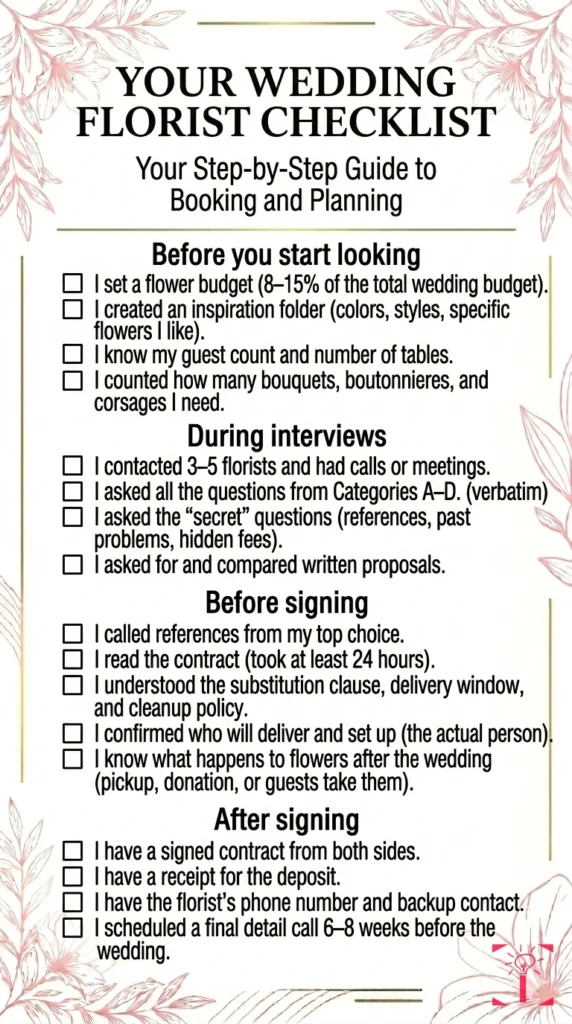
Final Checklist (Print This!)
Use this checklist to make sure you haven’t missed anything.
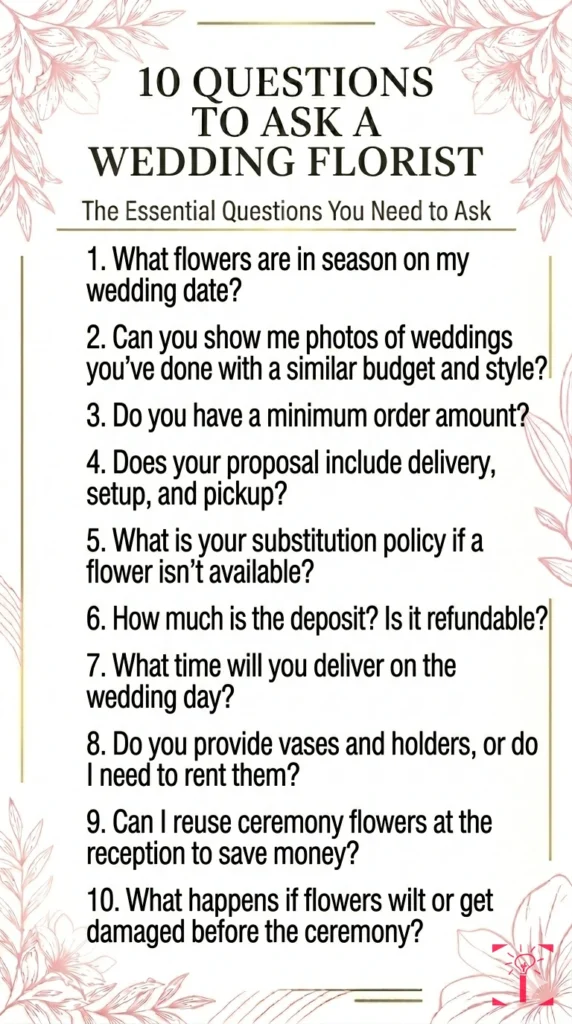
Quick Reference Card – 10 Easy Questions to Ask Any Wedding Florist
Save it on pinterest or print it!
Your wedding flowers will be gone by Monday morning, but the way they made you feel walking down that aisle, the way they looked in every photograph, the way the whole room smelled like something out of a dream, that, that feeling right there? Stays forever.
The right florist doesn’t just arrange flowers; they translate the feeling you’ve been carrying around in your head into something real and beautiful and completely yours. You now have everything you need to find that person with confidence. Go get your flowers.
