
21 Sage Green Wedding Decor Ideas
This list gives you 21 ways to use sage green in your wedding decor. Some are meant for couples who want just a touch of the color, and others suit couples who want it to run through the whole day. You can pick one idea or build a full plan from several. Sage green is a soft, grayish green, so it sits well next to many other colors. That makes it easy to adjust to your own taste. Each idea below has a photo and a short note so you can see how it might work. Keep a running list as you scroll. Mark the ones that fit your venue, your guest count, and your budget. Then cross off the rest. By the end, you should have a clear short list of decor to bring to your planner, florist, or whoever is helping you set up. Start at the top.
Sage Head Table Florals
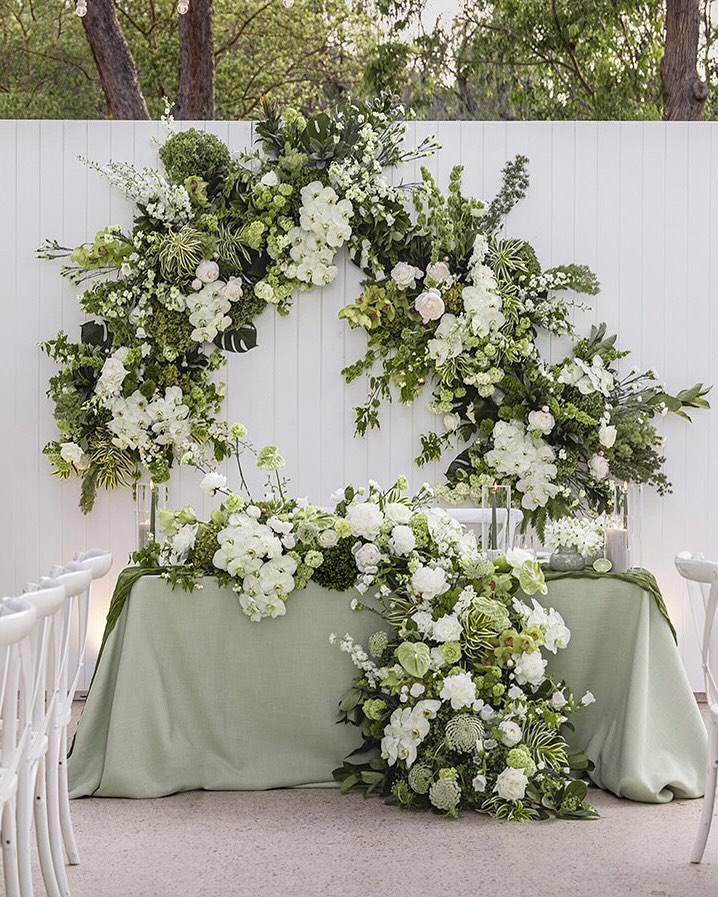
Start with the sage tablecloth, then place the head table against a plain backdrop so the flowers have room to stand out. Build an off-center sweep of greenery and white blooms above it, with fuller clusters at either end and a lighter stretch through the middle. Secure the support to the wall or fence before adding stems; the weight should rest on the frame, not on the flowers or fabric.
Once the backdrop is in place, add a low floral line across the tabletop and let one section spill down the front to the floor. That link between the overhead flowers and the table keeps the arrangements from looking separate. Gather the densest part of the cascade near one corner, then taper it with greenery and smaller blooms. Leave clear cloth around the flowers so the sage remains visible, and keep the tabletop arrangement low enough for guests to see across the table. Finish with a few glass candle holders near the back, where they won’t interrupt the flowers.
Sage Green Table Numbers
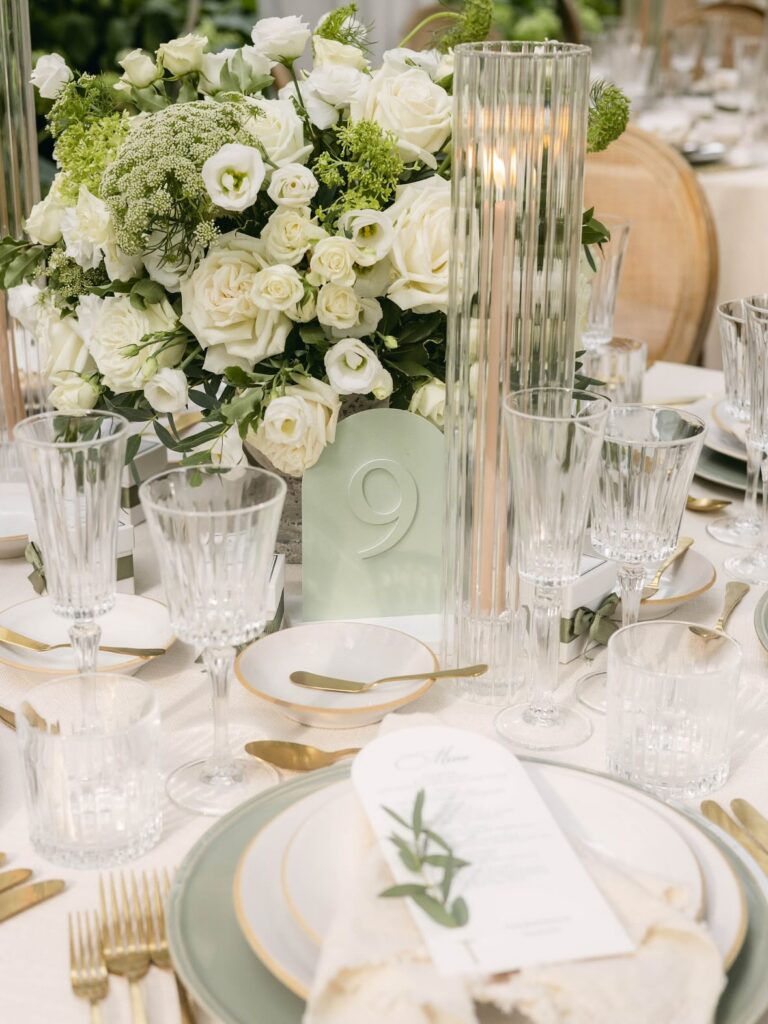
Give each table a sage green number sign with an arched top and a raised numeral. Set it just in front of the flowers, with enough room around the number for guests to spot it from the aisle.
For more contrast than pale sage lettering on a matching base, paint the arch a deeper sage and make the numeral ivory. The darker background makes the number easier to read, especially beside a large arrangement of white flowers. Choose a muted green rather than a shade that leans blue, and carry that same color across every table.
With this darker version, leave the face free of extra text or decoration. The raised number already adds depth, so a border would crowd it. A matte finish also helps the lettering stay clear when candles or overhead lights catch the front of the sign.
Sage Green Charger Plates
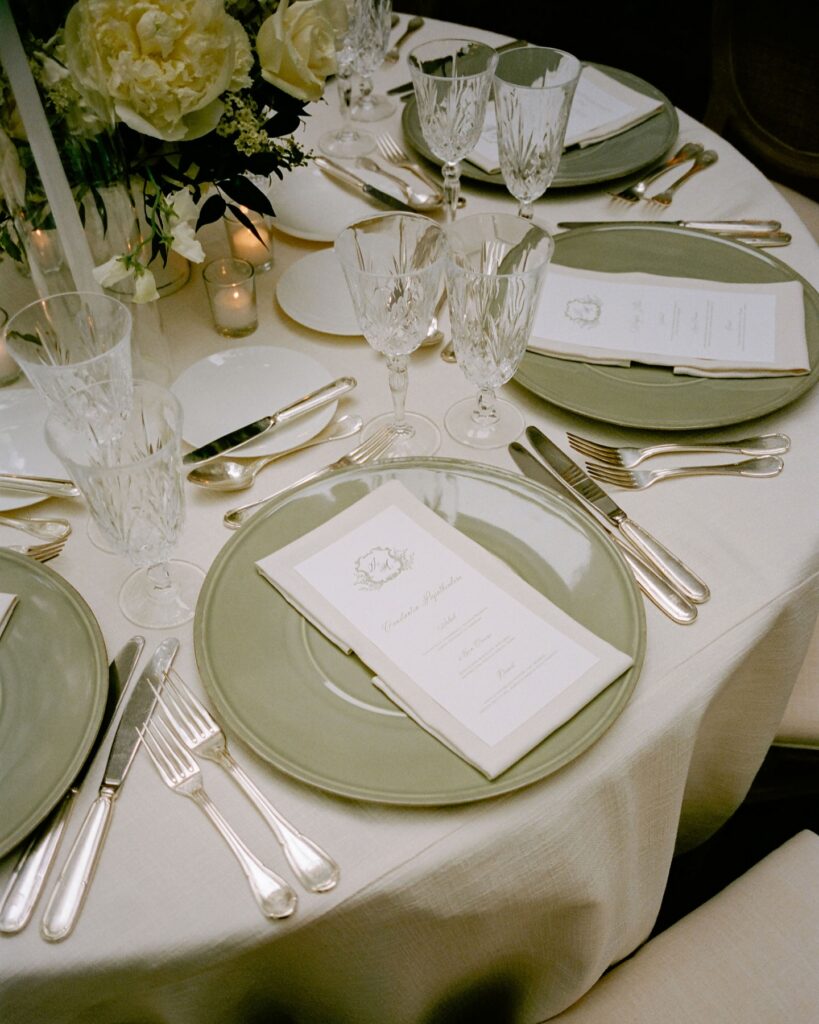
Sage chargers under a plain white plate or a folded menu give the table its color without needing any other green. The ones here are glazed ceramic with a wide rim and a shallow well, and they sit on an ivory linen cloth with a slight weave. If you can’t rent ceramic, glass chargers work if you tint them from underneath with a sage napkin or a sheet of paper cut to size.
Keep the cloth, glassware and silver in neutral tones so the plates are the only green. Cut crystal and silver flatware both pick up the sage without competing with it.
Sage Green Hand Fans
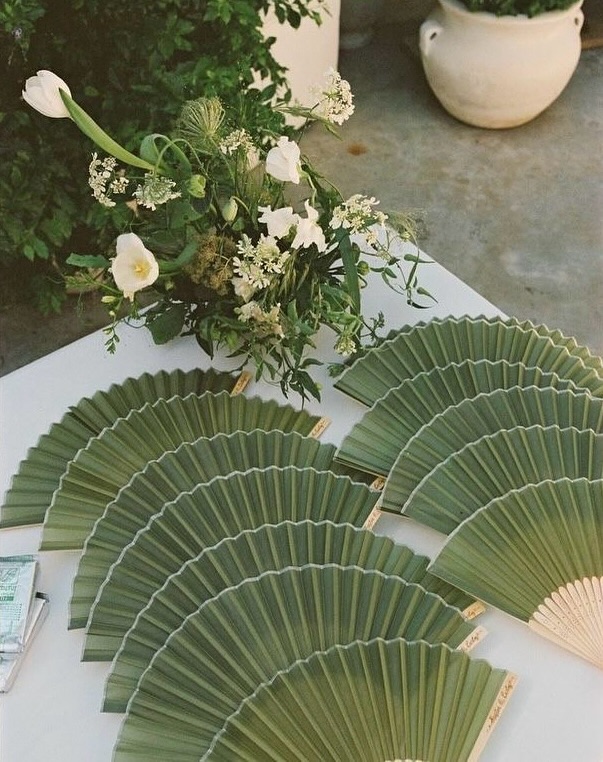
At an outdoor ceremony, place a sage green hand fan on each seat before guests arrive, with the handle angled toward the aisle for easy access. This is especially useful for a garden or courtyard ceremony in direct sun. The pleated fans can sit on chair cushions or beside the program, ready for guests to use during the vows and photographs.
At the reception, arrange extras in rows on the welcome table near the guest book or seating cards. A small flower arrangement at one end gives the fans a clear place without covering them. Their folded shape makes them easy to line up, and guests can take one as they enter. For an indoor ceremony, set a few on the reception tables instead of placing one on every seat, and leave the rest near the entrance.
Sage Checkerboard Dance Floor
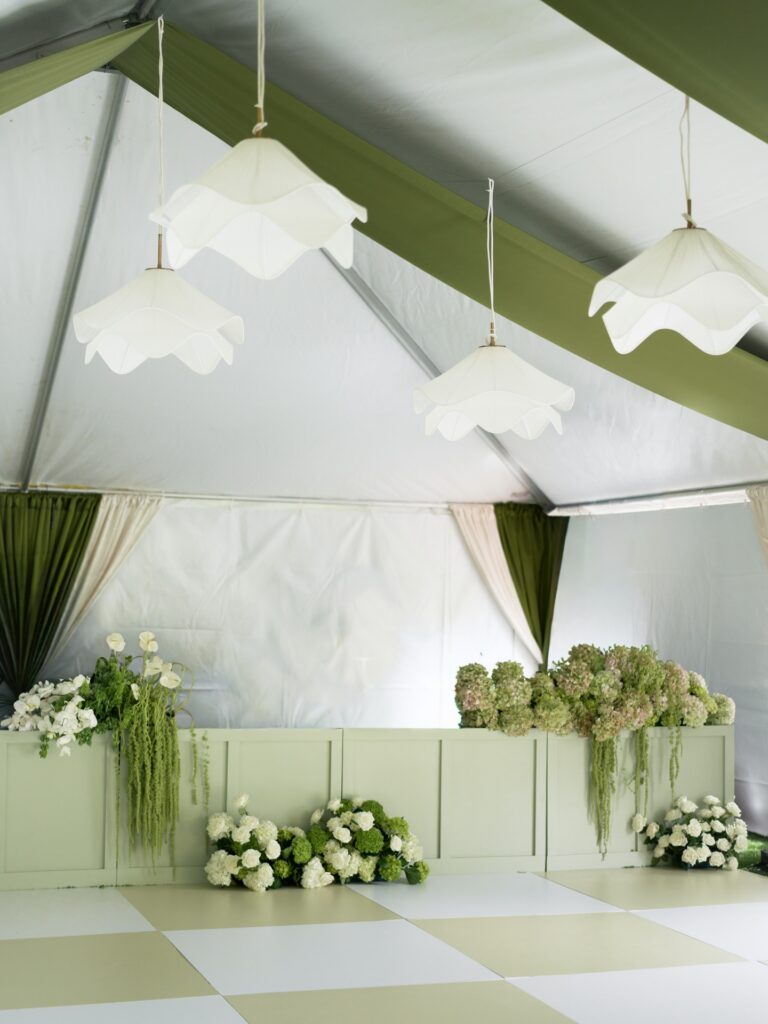
Choose a sage and white checkerboard floor if you want the dance area to be a big part of your decor. Large squares work best where there’s room to see the pattern. If your floor will be mostly covered by tables, put the green in your linens instead.
Striped Skirted Bar Fronts
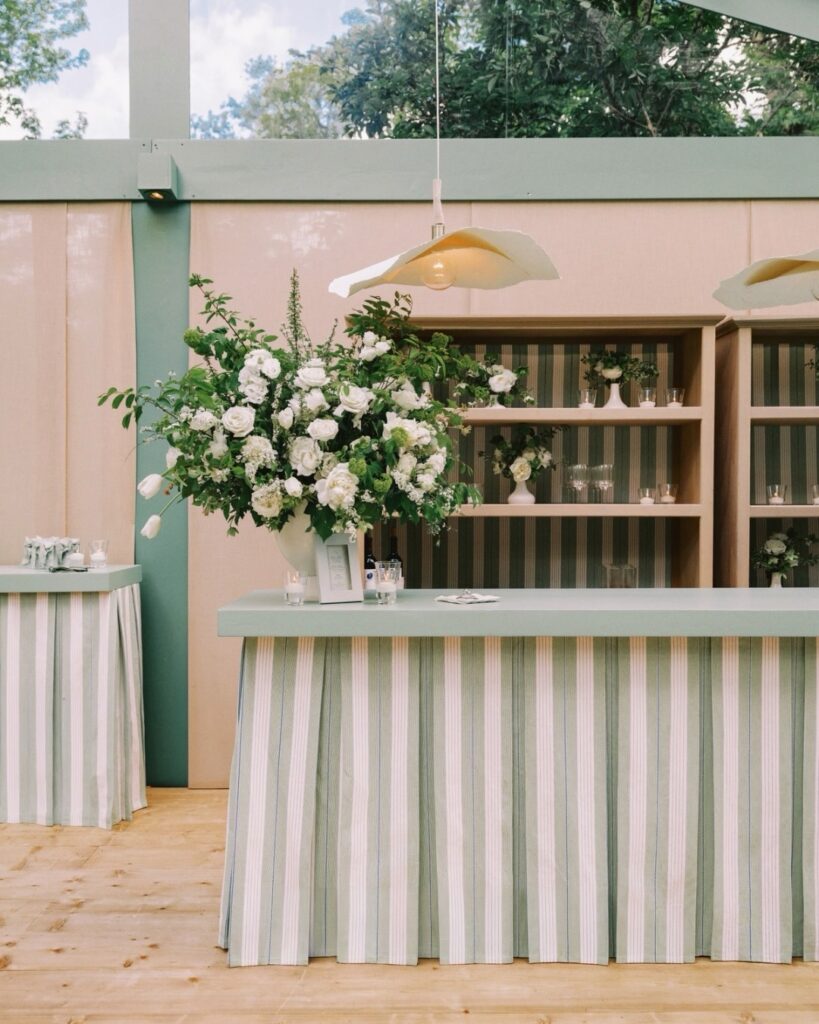
A fabric skirt on a bar or cocktail table gives you a lot of sage for little money, but the stripe has to be sized to the piece. Here the stripes run about as wide as a hand, which holds up from across a tent. A thin pinstripe would blur into a flat gray-green at that distance, so check a swatch outside before you order yardage.
Pleats are the other place it goes wrong. Fabric gathered too tightly looks like a ruffled curtain, and fabric gathered too loosely sags and shows the table edge. Ask for fullness of roughly double the table’s width, and have the hem stop just above the floor so it doesn’t pick up dirt.
The tabletop should be a solid green close to the stripe’s darkest shade. If it’s too far off, the two read as separate pieces. I’d also keep the arrangement on top all white and green, since any other color will fight the stripes.
Sage Entrance Draping
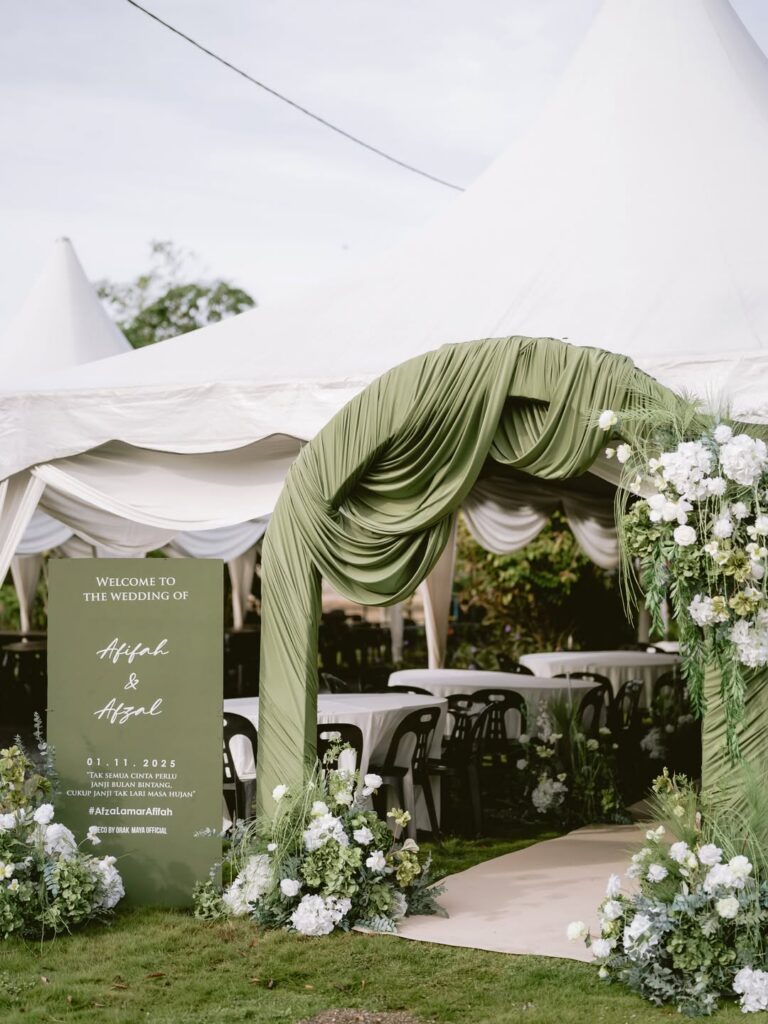
A sage-green fabric swag gives the tent entrance a clear frame. Gather the cloth across the top, then let one long section fall down the side so the folds stay visible from a distance. The deep pleats matter more than a broad flat panel; without them, the fabric can look like a plain strip laid over the canopy.
Keep the rest of the entrance open enough for guests to see the tables inside. A cluster of white flowers at the base can link the drape to the greenery, while the fabric’s muted color keeps the doorway from competing with the sign or flowers. Use a fabric with enough weight to hold the folds.
Sage Green Flower Plinths
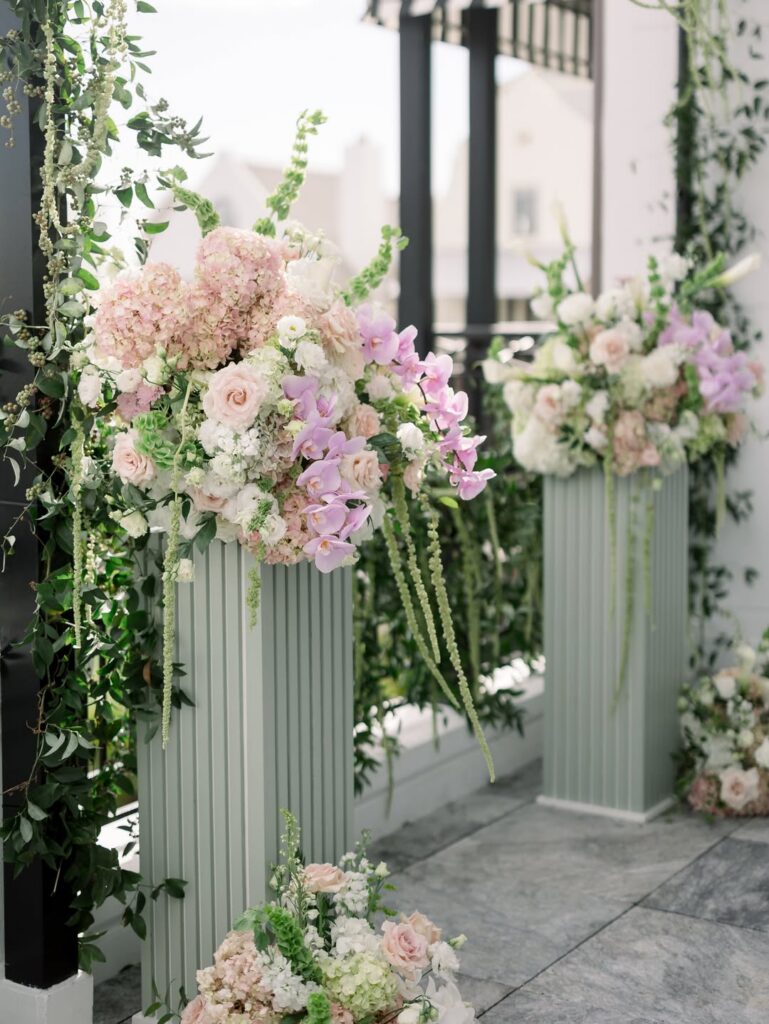
Set ceremony flowers on sage green plinths, with ribbed sides that carry the color down toward the floor. For a smaller setup, use shorter plinths and narrower arrangements so the green bases still show beneath the blooms rather than disappearing under them. Let pale pink roses and white flowers hang just over the edges, with a few trailing stems to link the flowers to the base without hiding its shape.
Sage Bar Menu Sign
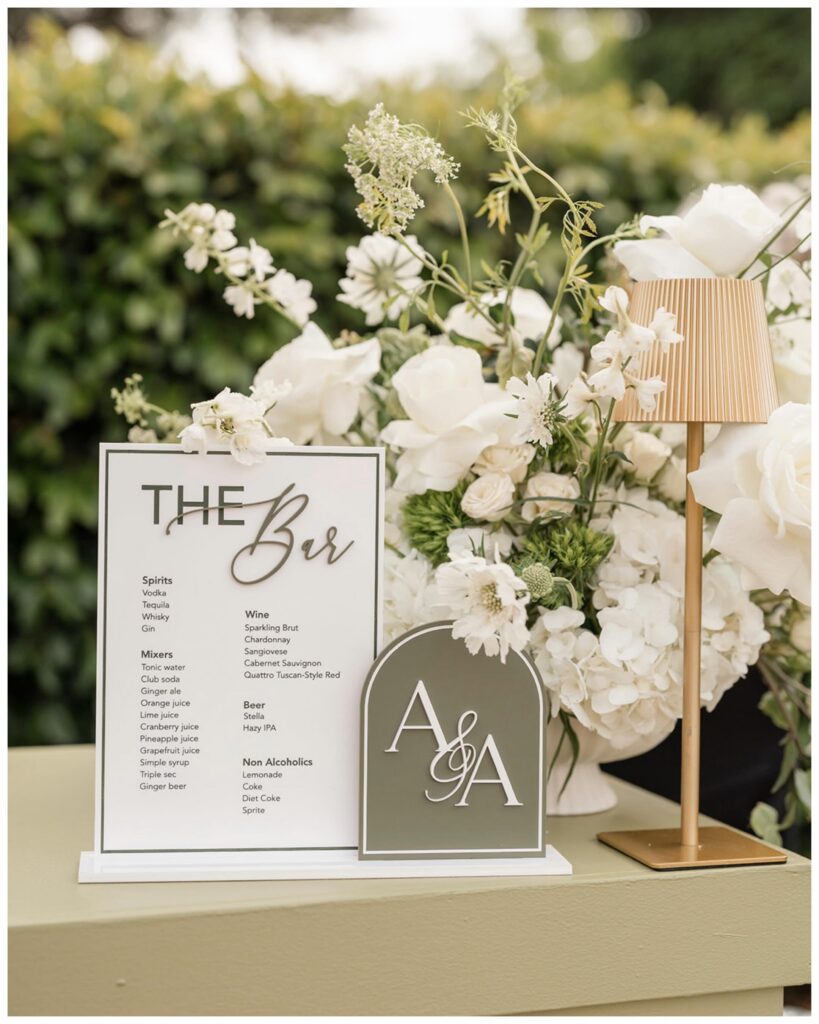
Start with the menu wording, because everything else is sized around it. List the drinks first, grouped into spirits, mixers, wine, beer and non-alcoholic, then count the lines to decide how tall the sign needs to be. Print it in dark gray on white acrylic so the small type stays readable from a few feet away.
Once the menu is set, make a second, smaller sign in sage with the couple’s initials in white, and cut the top into an arch. Stand it against the lower corner of the menu so the two overlap a little. Put the pair next to a low flower arrangement and a table lamp, and check that the flowers sit behind the text, not over it.
Sage Green Display Shelves
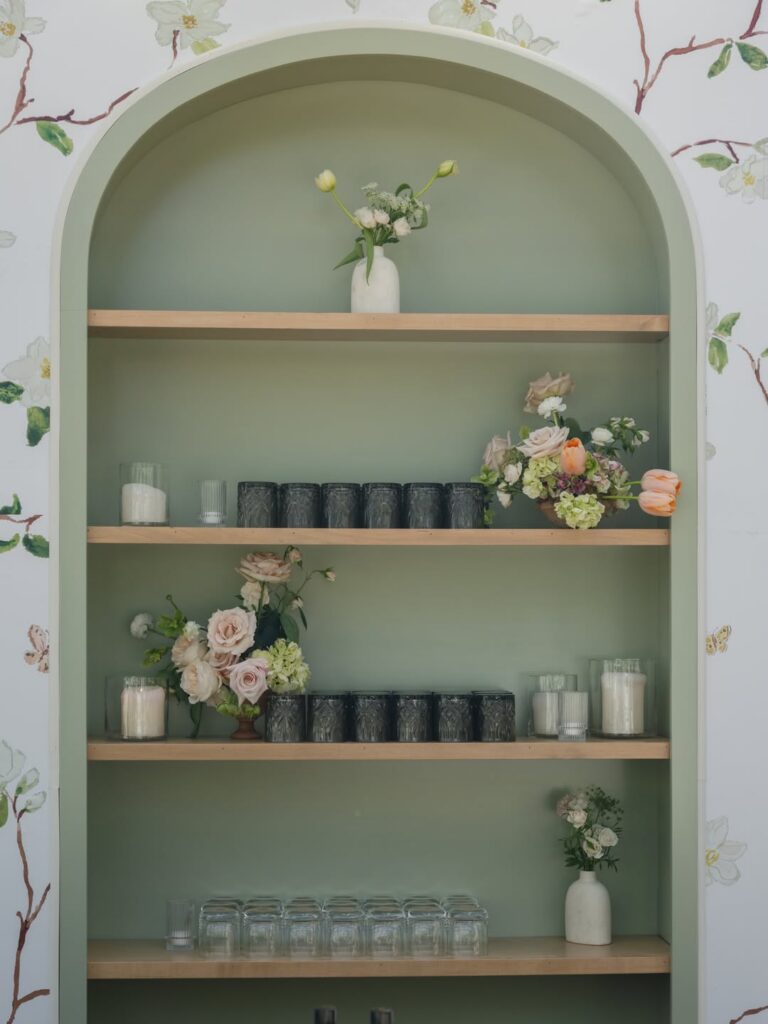
A sage-painted arched niche can hold the smaller pieces that tend to crowd reception tables. Set it behind the guest book, near the bar, or along the entry wall, where guests can see the display without needing to reach around it. A few low flower arrangements can break up rows of glass candle cups, while a slim wood shelf adds a line across the green.
Keep the pieces spaced along each level, and leave the top shelf for a single vase so the arrangement has room to breathe.
Floor-Length Sage Table Linens
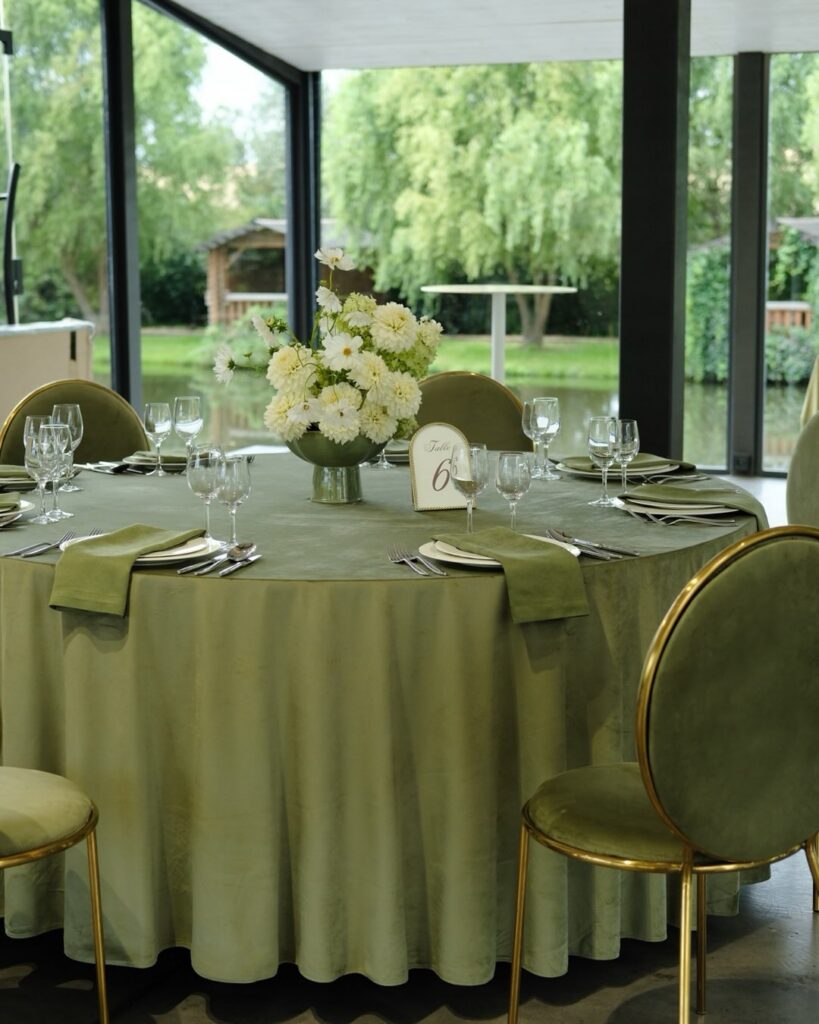
Dress round tables in sage green cloths that reach the floor, with enough fabric to fall in loose folds rather than pull tight across the top. Linen gives you more texture, while matte polyester is an option if you need lots of matching cloths.
Choose cloth napkins in the same shade, and drape them over the table edge beneath white plates. If an exact match is hard to find, use a slightly darker green for the napkins rather than mixing greens with noticeably different yellow or blue undertones.
Hanging Calla Lily Installation
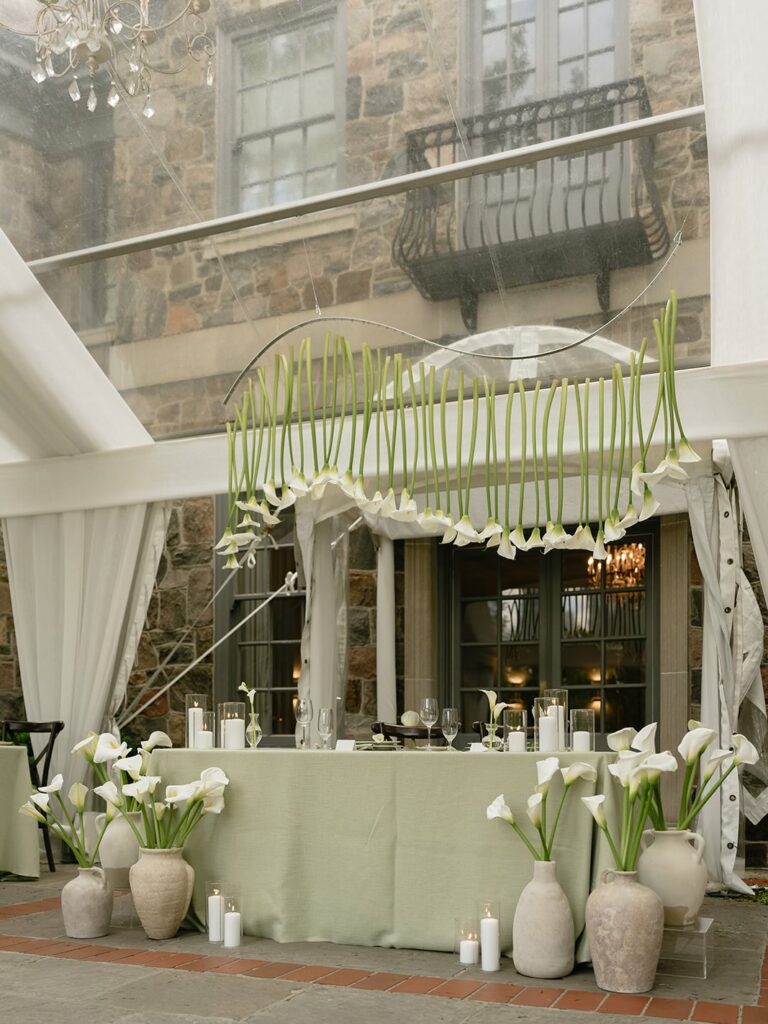
Flowers hung upside down from a frame look dramatic, but the stems are where it goes wrong. Calla lilies are long and heavy at the bloom end, so if they’re wired loosely they twist, bunch up, and the row loses its clean edge. Fix each stem to the frame at the same height and spacing, and let the blooms fall in one even line.
Hanging flowers also need to be kept in water until the last possible hour, because callas wilt fast out of a vase. Ask your florist to use water tubes or to hang them as late as they can.
Keep the table below plain, as it is here with a sage linen, pale stone vases, and white pillar candles in glass. Anything busier would compete with the installation. I’d also keep the candles away from the stems overhead, since a flame near dry greenery is a risk you don’t need.
Sage Favor Display
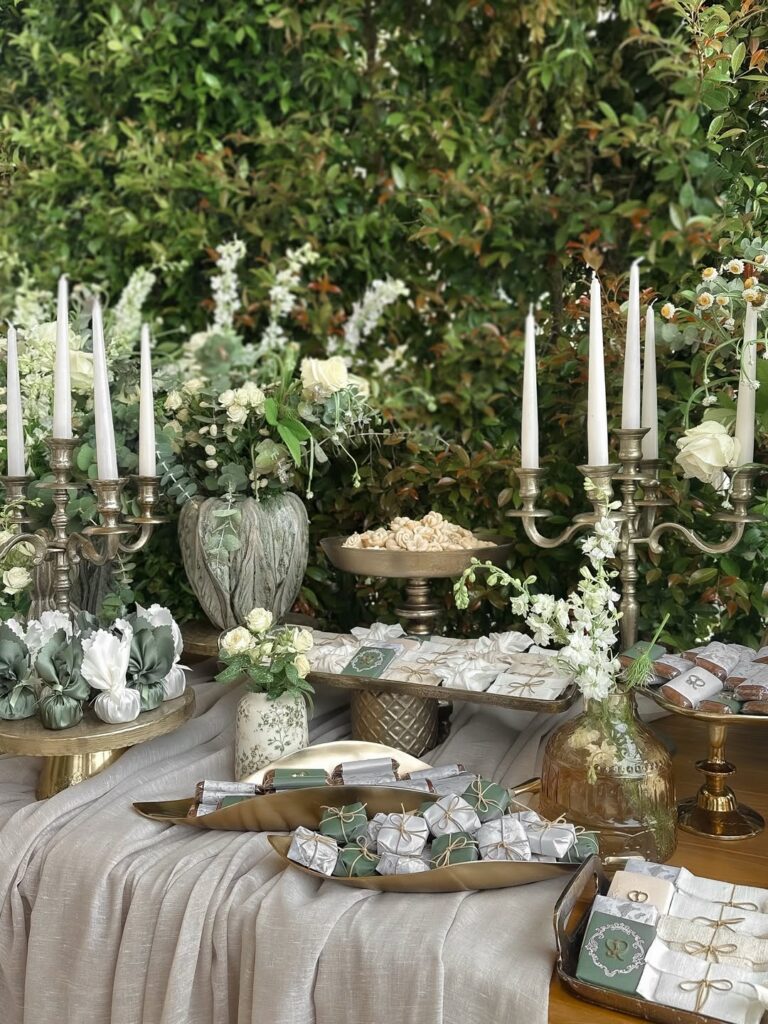
Small favors wrapped in sage paper and tied with natural cord give guests something to collect as they pass the reception table. This display works well for couples who want favors to sit alongside the flowers and candles rather than be handed out separately. Shallow brass trays can hold the boxes, with white flowers nearby to keep the green packaging from feeling too dominant.
For a large wedding where guests need to move through quickly, or for a couple who wants less setup and less table clutter, a detailed favor display may be the wrong choice. One favor at each place setting is easier to manage. If you use trays, choose ones with enough room for guests to reach in without shifting the other boxes.
Sage Green Draped Canopy
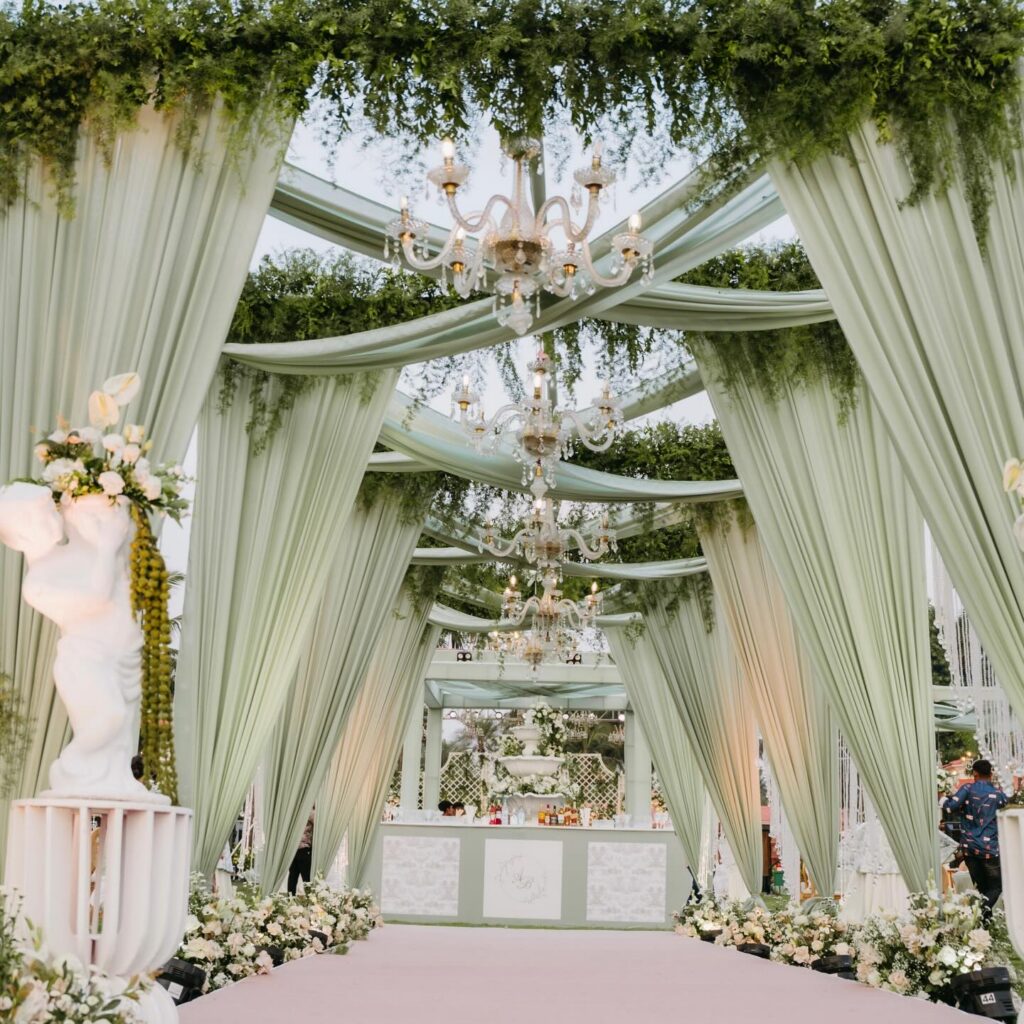
Gather sage green fabric into tall side panels, then carry it overhead in loose swags rather than stretching it flat. The extra fabric is what makes this canopy work: deep folds give the pale color some depth, while the dips overhead break up the straight run of the aisle.
Without that fullness, the panels would look more like partitions, and the ceiling fabric would feel like a cover rather than part of the decor. Leave gaps between the overhead swags so daylight can come through and the chandeliers have room to hang below them.
Sage Fringed Lamp Shades
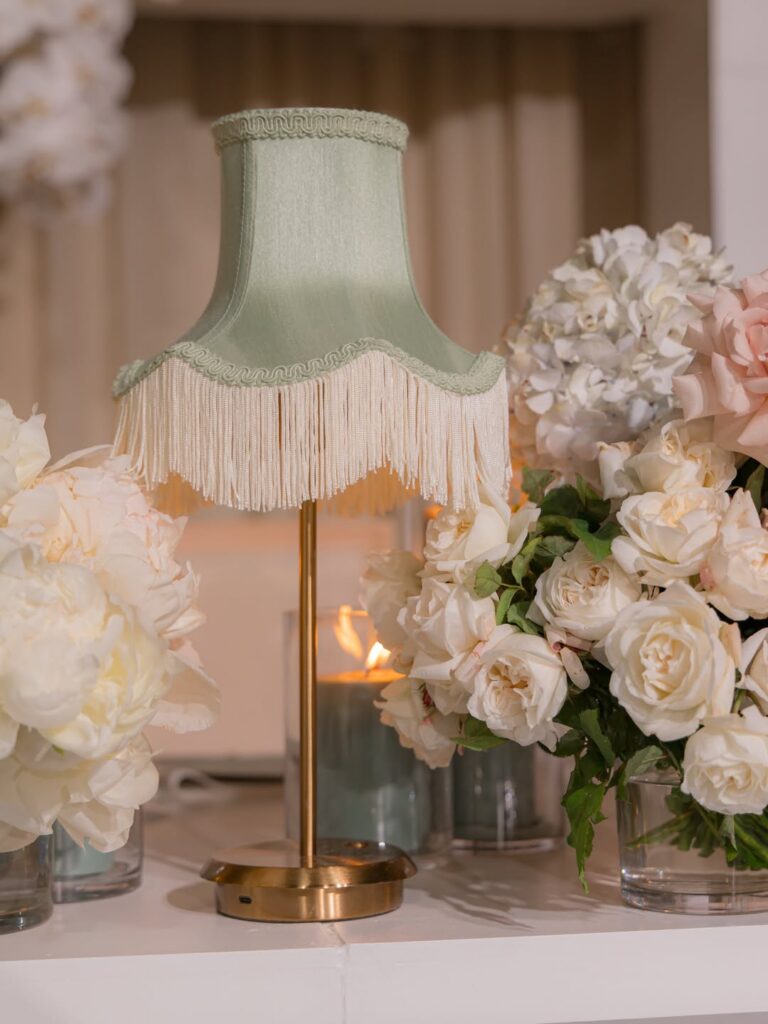
A small table lamp with a sage green shade and a cream fringe can stand in for flowers or candles on a reception table or a mantel. The shade here is a fabric bell shape with a scalloped hem, a braided trim in the same green along the top and bottom edge, and a skirt of cream fringe hanging below. The base is a thin brass stem on a round brass foot, which keeps the metal quiet so the fabric gets the attention.
If you want to make one, start with a plain bell or empire shade in a pale fabric. Glue braided gimp trim along the top and bottom edges, then sew or glue a strip of ball or tassel fringe under the lower trim. A fabric shade in a flat, slightly textured weave takes the green better than a shiny one.
If you’d rather not sew, a cordless rechargeable base is easier to place and leaves no wires across the table. Without a sage shade, wrap a white one in sage ribbon or fabric, or dye the fabric before you trim it. I’d keep the fringe cream or ivory so it matches the flowers beside it.
Sage Green Floral Loop
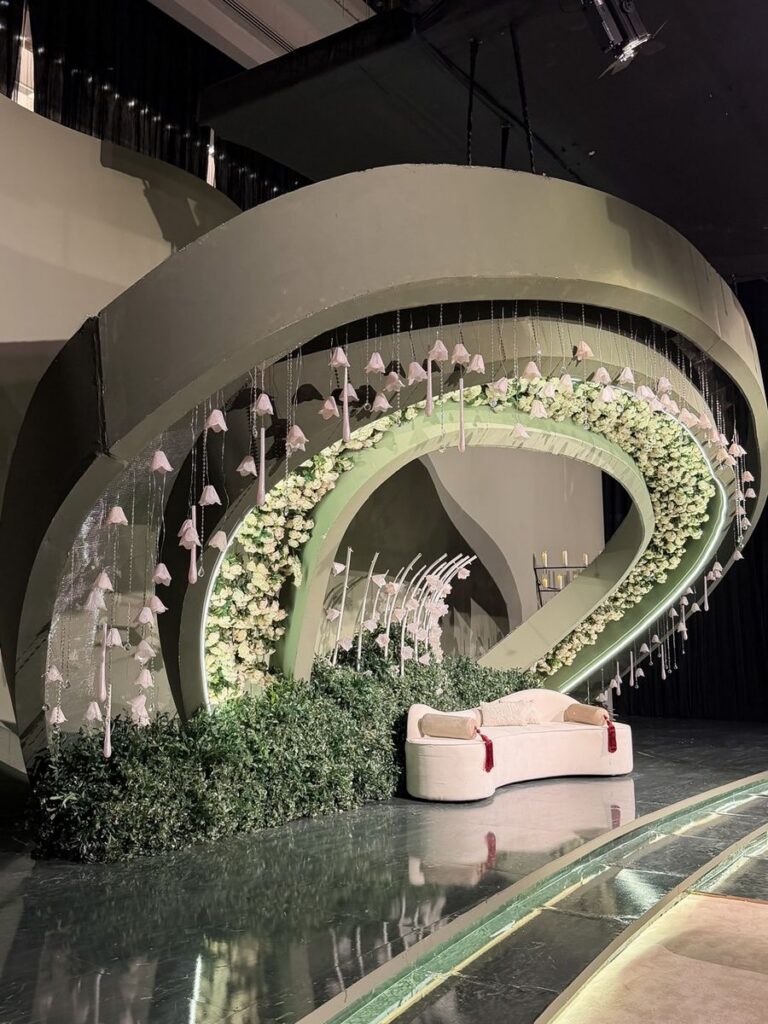
A broad sage-green loop framed with flowers can anchor a ceremony stage or the seating area behind a sweetheart sofa. The curved structure gives the flowers a clear path around the couple, while small hanging ornaments add detail beneath the arch without covering the greenery. Keeping the flowers in a narrow band leaves the green frame visible.
This idea is for couples who want one large focal point and have a room with enough height and floor space to carry it. It works especially well when guests will see the installation from a distance, since a small backdrop can disappear in a large hall. The setup also gives a photographer a defined spot for portraits. Couples planning a small gathering, using a low-ceiling room, or preferring decor spread across tables may want a different approach; this structure concentrates most of the visual detail in one place. I’d keep the surrounding stage clear so the frame and flowers remain easy to see.
Monogrammed Sage Lounge Cushions
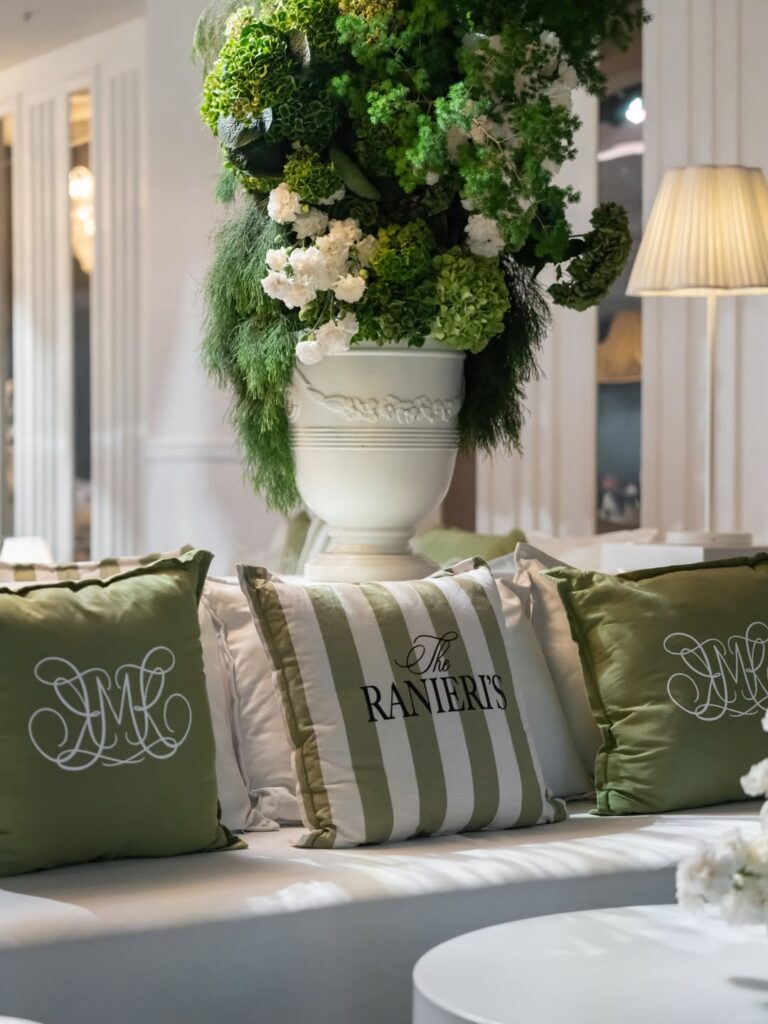
Add embroidered monograms to sage green cushions on your wedding lounge seating. For a less formal version, choose matte linen rather than glossy fabric; its visible weave gives the cushions more texture and cuts down on shine under lamps. White thread stands out against the green, while cream makes the contrast less sharp.
Carry the linen through to a striped center cushion, with your names stitched smaller so the lettering leaves more of the stripes visible.
Tall Draped Fabric Columns
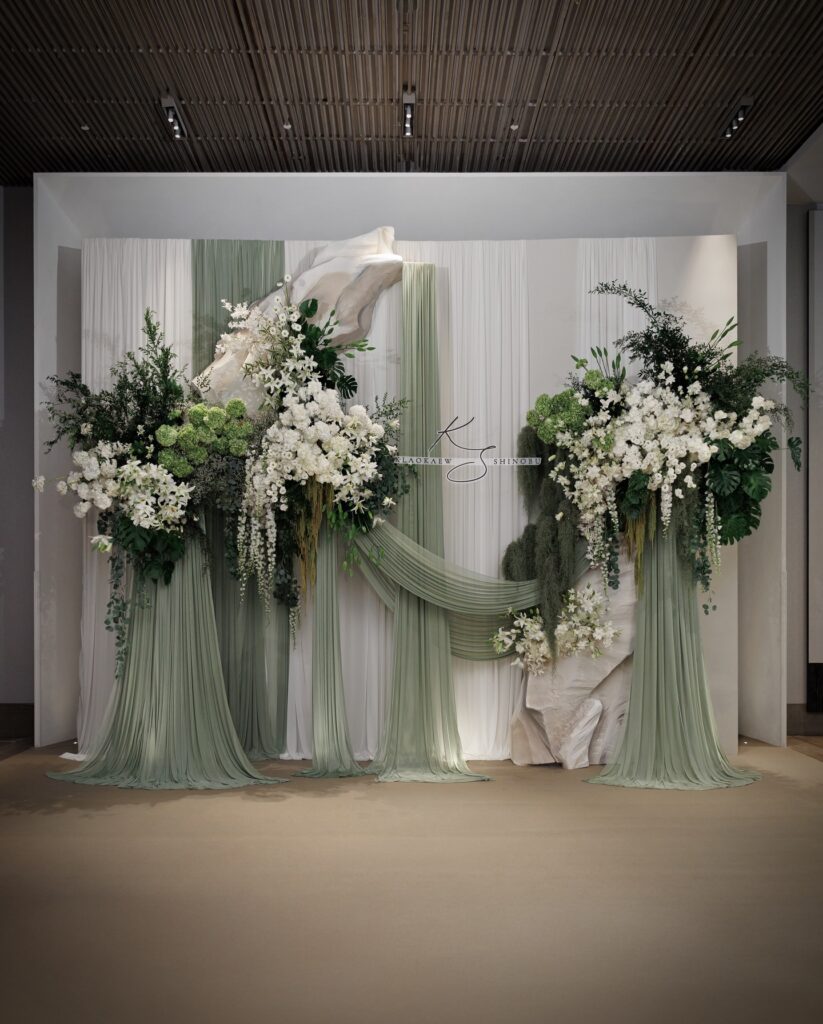
Fabric hung from the top of each floral arrangement and left to pool on the floor gives the backdrop its height. Here the sage chiffon falls in long, uneven folds from the flowers down to the ground, and a loose swag links the two sides.
Without that fall, the white hydrangea and greenery would sit as two heavy clusters on a plain white wall. Let the hem spread out on the floor.
Sage Green Escort Card Wall
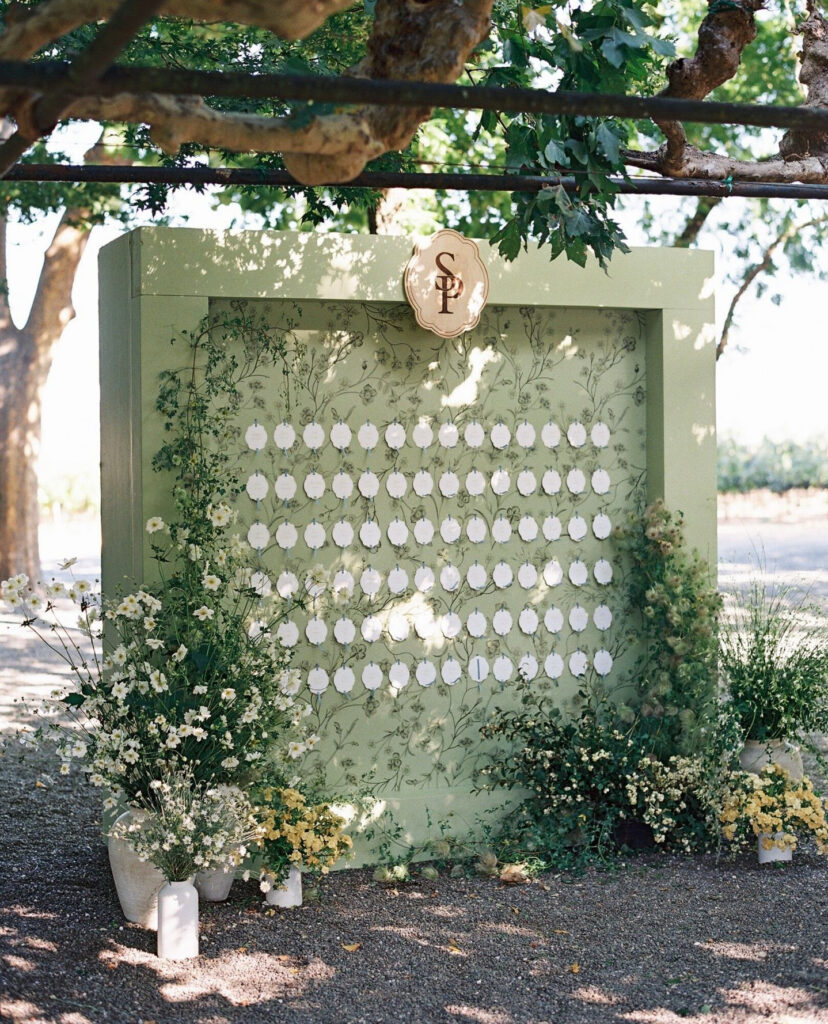
A sage green escort-card wall gives guests a place to find their seats, but tiny cards can turn that pause into a bottleneck. Use lettering large enough to read from a step away, and print names and table numbers in dark ink with strong contrast against the pale cards. Arrange them in straight, evenly spaced rows, then sort them alphabetically rather than by table so guests do not have to scan every line.
Leave space in front for people to stop without blocking the path. A panel can hold many cards, though crowding it with flowers or trailing greenery makes the edges harder to reach and the names harder to see. Keep flowers low and to the sides. Outdoors, anchor the board and check that shifting shade does not leave the text in shadow. Put a stack of blank cards nearby for last-minute seating changes.
Sage Ribbon Menu Bows
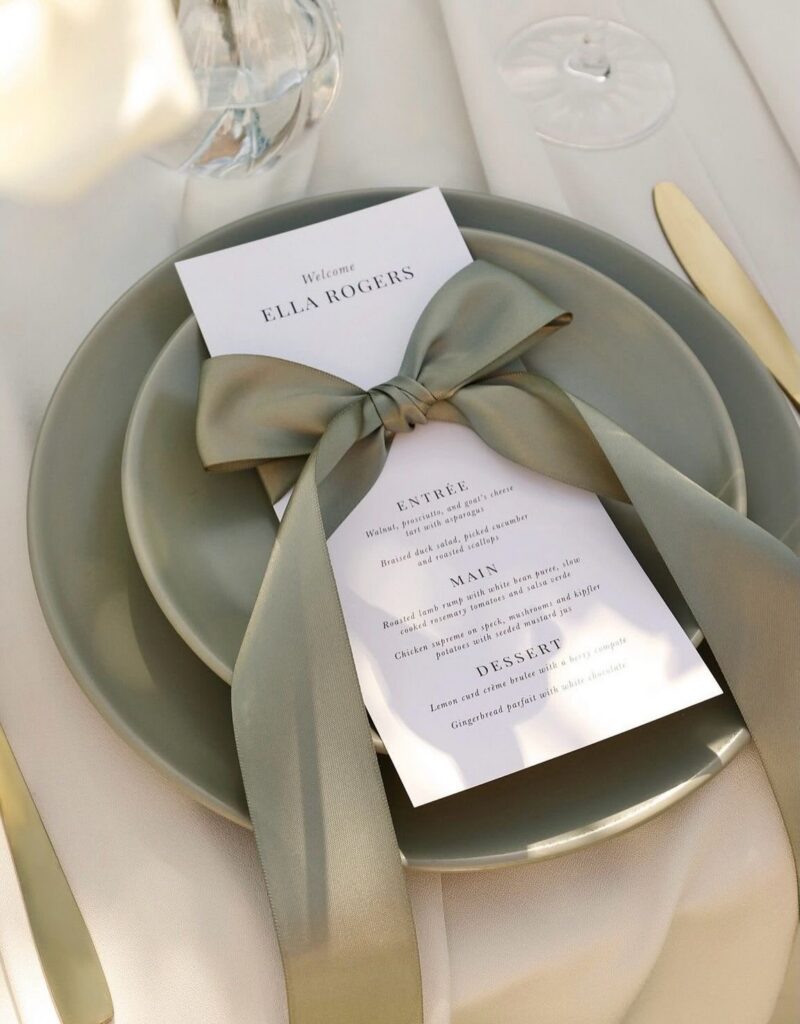
Tie a wide sage ribbon around each menu card before setting it on the plate. Position the knot in the gap between the guest’s name and the menu, so the bow leaves both readable. Let the tails fall past the plate’s edge rather than tucking them underneath.
Arched Welcome Sign in Sage
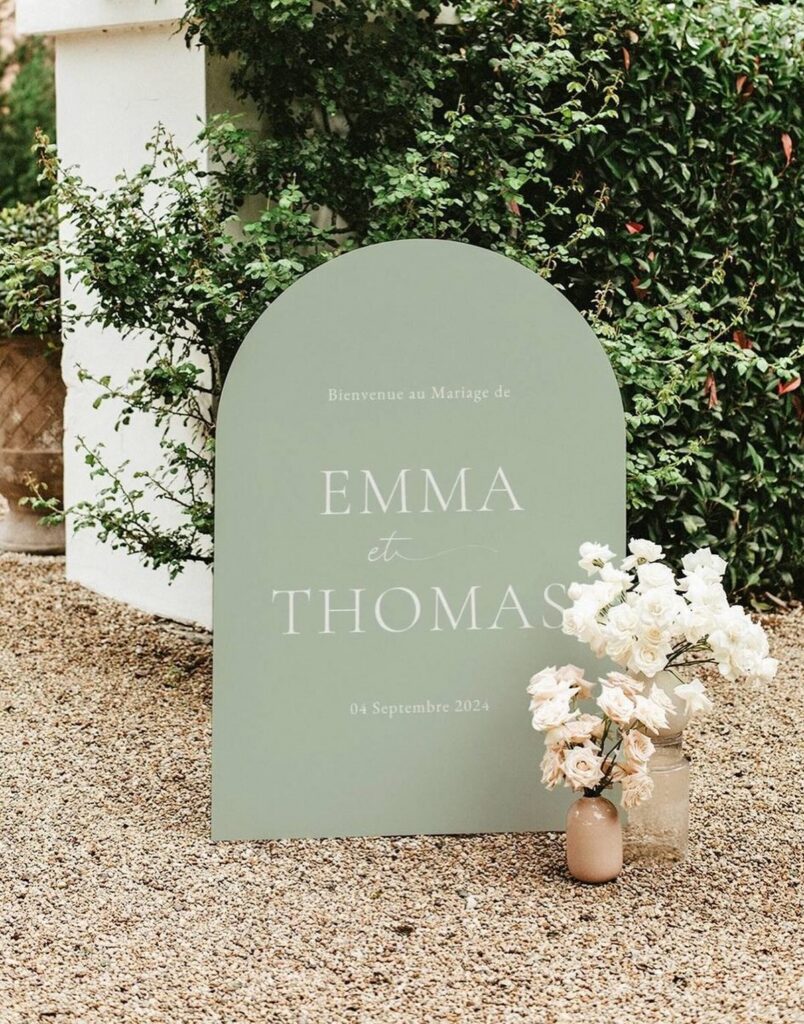
A sage arch sign belongs at the spot where guests first slow down, which is usually the gate, the end of the driveway, or the start of the path to the ceremony. Gravel and a hedge behind it make a good setting because the green sits against the leaves without disappearing into them. Leaning it on the ground works fine if the base is level.
Put the flowers on the side guests walk past last, so the names stay clear. White lettering needs daylight to stay readable, so I’d move it indoors to the entry table for an evening reception.
